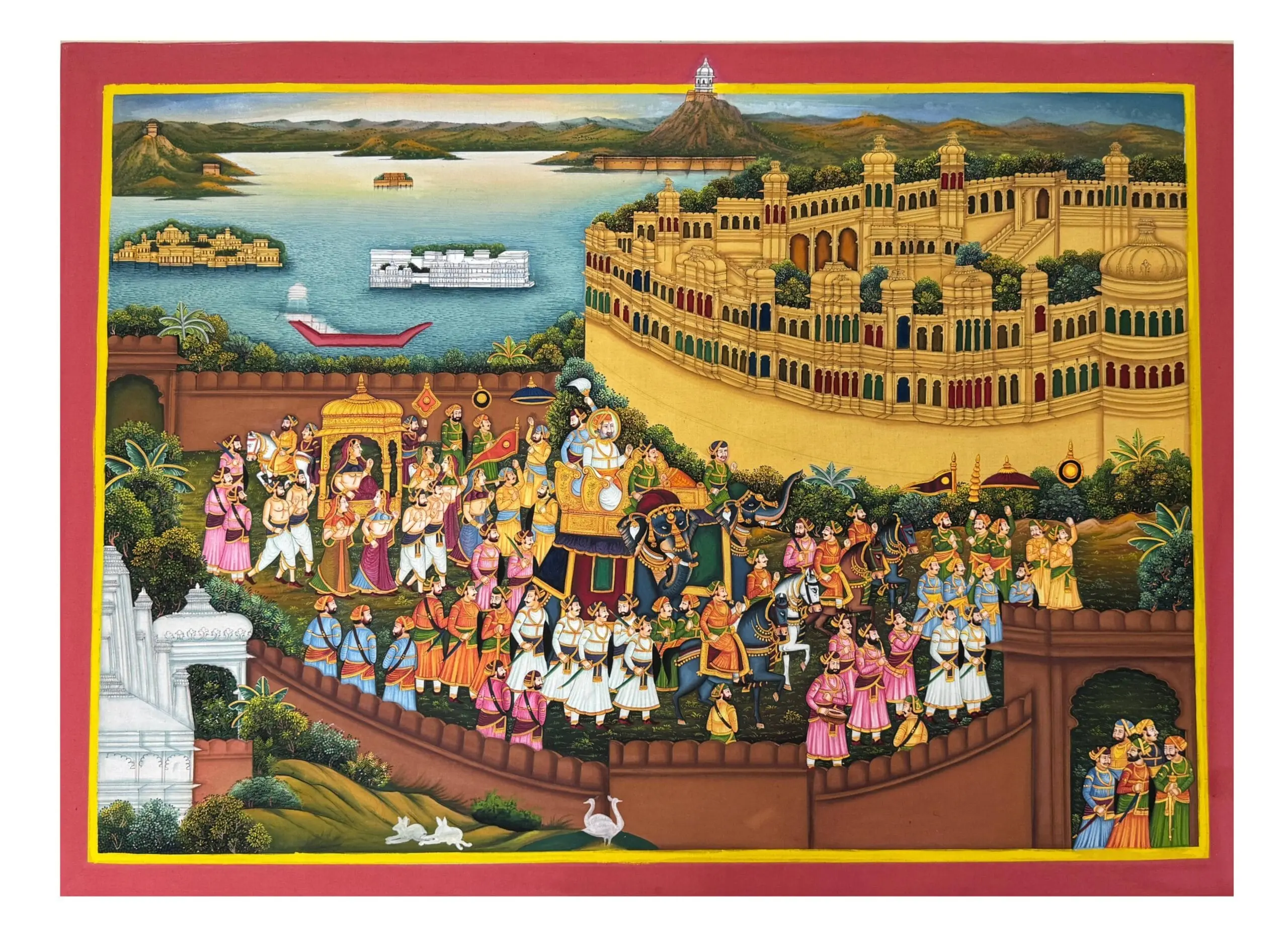
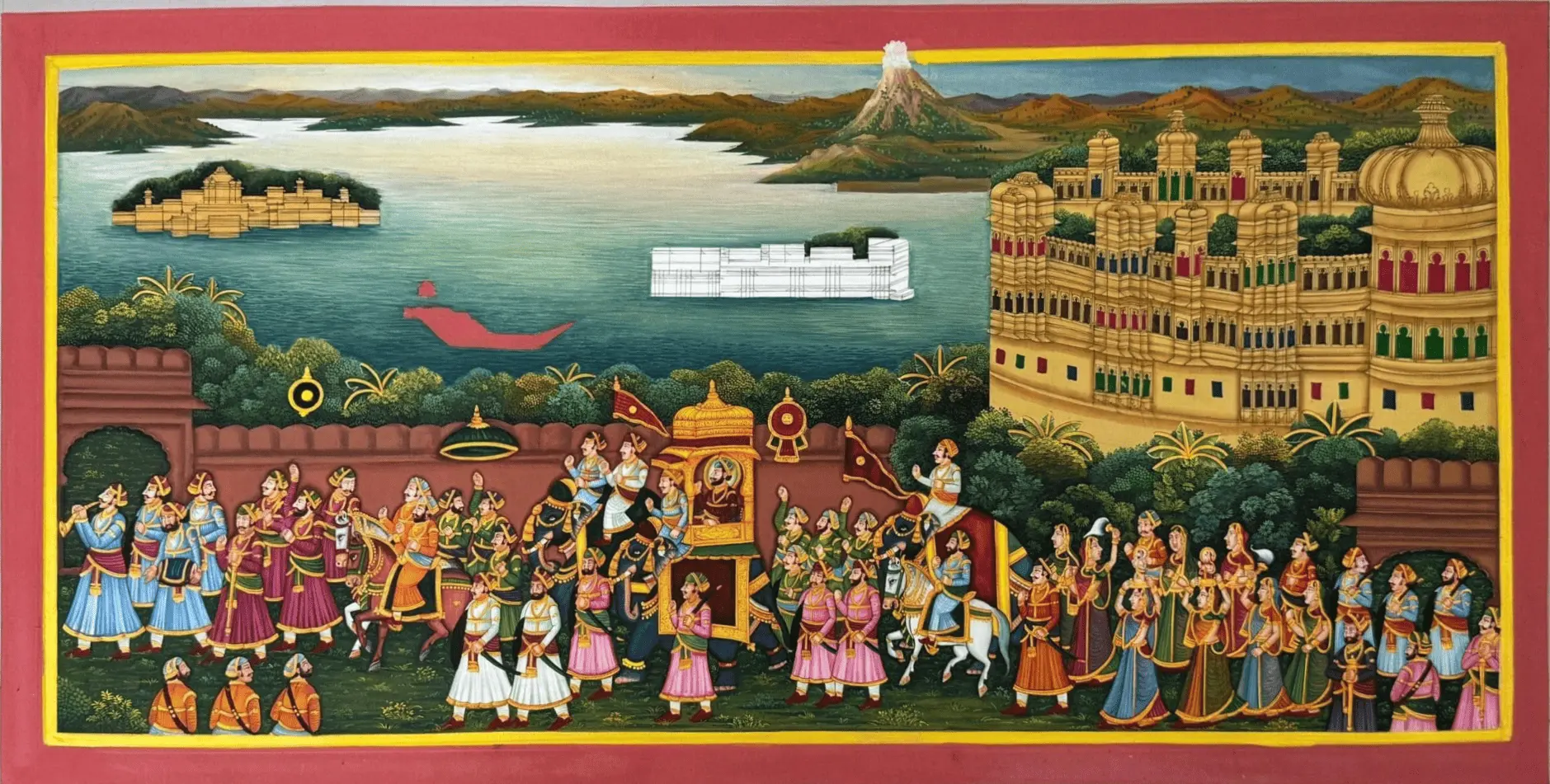
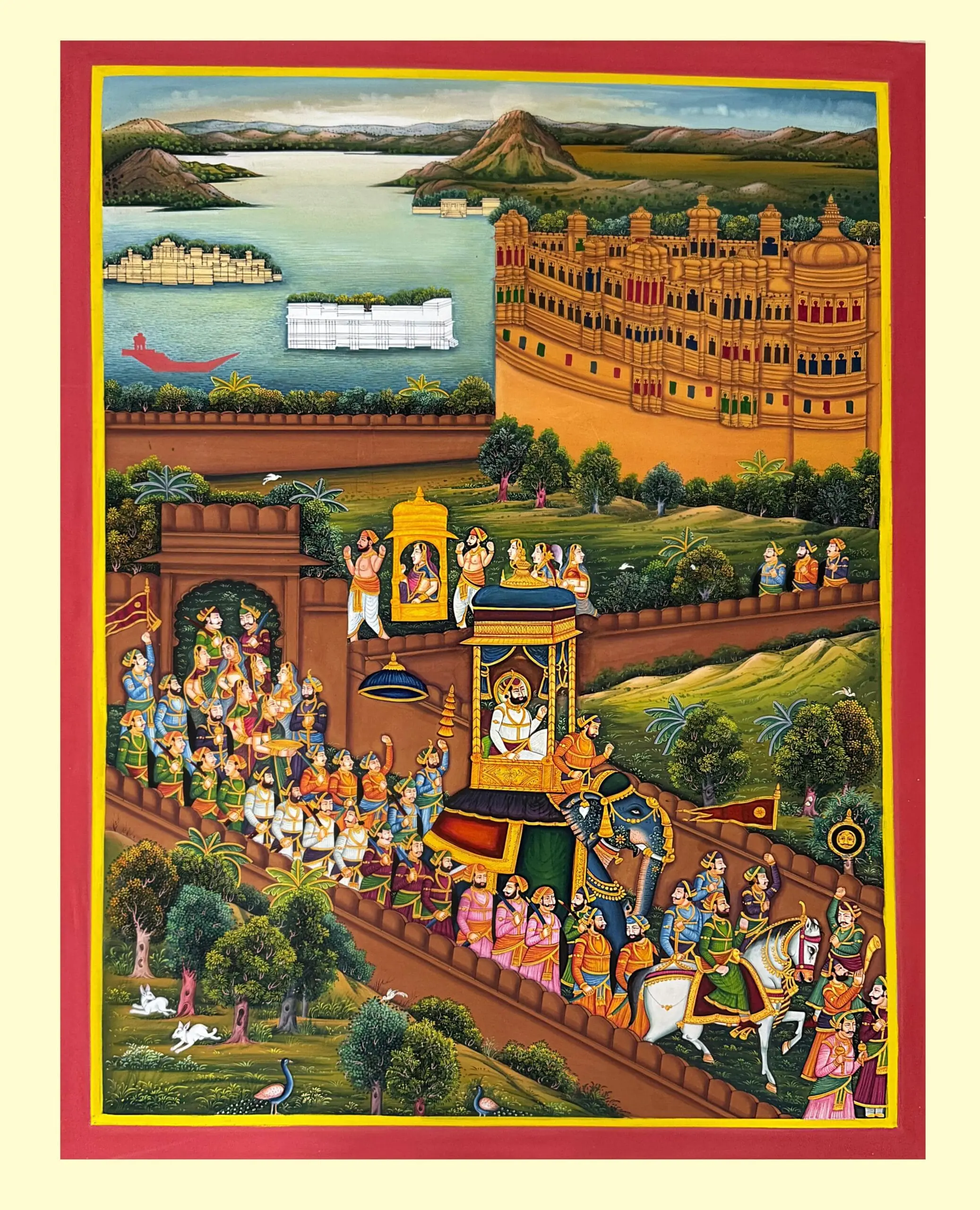
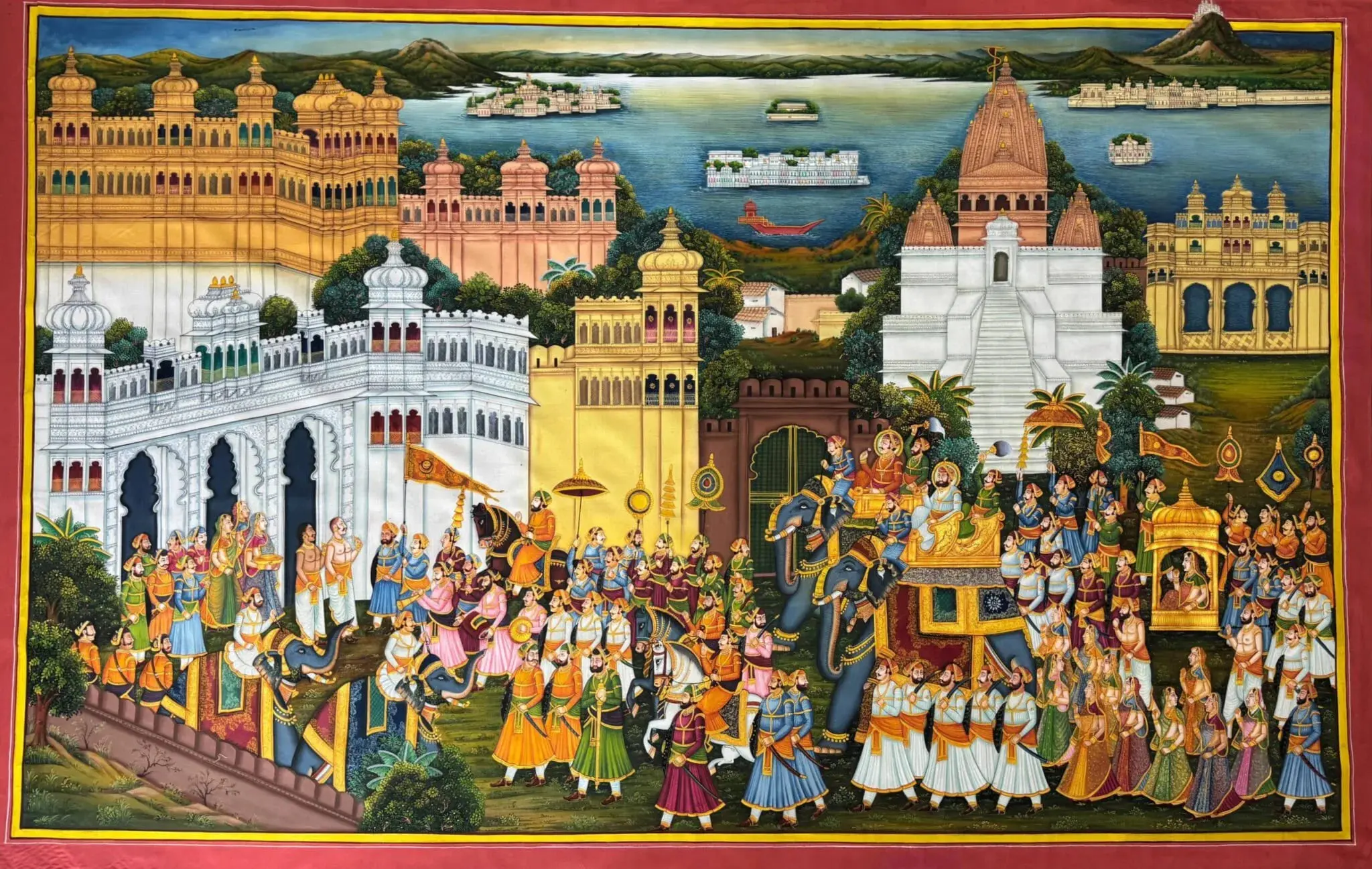
A seller sends you a photo of a royal procession painting. The caption says "original Rajasthani miniature, handmade." You cannot hold it, and a good print can look convincing on a phone screen. So what can you actually check?
This guide shows how to identify an original Rajasthani miniature painting using four things you can look at or ask about: the surface it is painted on, the colour, the gold, and the paperwork. It is written for newly painted works. For old and antique-style paper, read our guide to identifying authentic Mughal miniatures.
How to identify an original Rajasthani miniature painting
An original Rajasthani miniature is painted by hand, stroke by stroke, in opaque watercolour on a prepared surface, in the tradition of Rajput courts such as Mewar, Bundi and Kishangarh. Where gold appears, it is applied by hand. A print can imitate the look, but not the process.
No single sign proves it. A print can copy colour, and a genuine painting can be photographed badly. Check the four areas below together, and ask the seller to confirm each one in writing. For the wider art form and its schools, see our guide to Indian miniature paintings.
1. The surface: cotton cloth, silk cloth and paper
Many buyers assume a real miniature must be on paper. Paper is common, but it is not the only surface. The Smithsonian's National Museum of Asian Art lists a Mewar portrait of Maharana Amar Singh II, from around 1700, as "opaque watercolor and gold on cloth." A portrait of Maharana Bhim Singh, made around 1810 to 1820 in the workshop of Chokha, is listed as "opaque watercolor and gold on cotton". A third Mewar work in the same collection, of Maharana Ari Singh II, is on paper. So cotton cloth is not a warning sign.
Silk is a surface that some present-day studios choose. Treat it as a choice of material, not as proof of age or authenticity. Judge the painting by its hand work.
What to look for on cotton and silk
| Surface | What to look for | What to ask |
|---|---|---|
| Cotton cloth | A fine, even weave under a smooth prepared layer. Colour sits on top of the surface instead of soaking into the threads. | Is the cloth stretched and prepared before painting, and how? |
| Silk cloth | A soft lustre that shifts as the light changes, with fine, even threads. Colour sits on the surface. | Is it real silk or a silk-look polyester? Can you show an unpainted edge? |
| Print on fabric (warning sign) | The image often looks soaked into the weave, and the back may show the same picture. | Can you send a photo of the back of the painting? |
A photo of the back and of an unpainted edge is easy for a genuine seller to send, and it tells you a great deal.
2. The colour: opaque, matte and layered
Rajasthani miniatures use opaque colour, so the surface looks matte and slightly solid, not glossy or see-through. Look at a large area such as a sky or a robe. In hand painting, the tone varies a little from one patch to the next, and darker colours often sit under lighter ones. A print gives one even tone across the whole area.
"Natural colours" is a phrase to ask about, not just accept. Research on Rajasthani paintings in Harvard's collections, reported by Scroll, found a mix of materials. Prussian blue and smalt, both European, appear in some Rajasthani works, while Indian yellow, indigo and lamp black are Indian. The same research analysed 42 colourants from a contemporary Rajasthani artist's palette and matched them to colours in 16th-century manuscripts, including harital (an arsenic sulphide), hinglu (a mercury sulphide) and kajal (lamp black).
You cannot confirm a pigment from a photo. That needs lab tools such as spectroscopy, which museums use. What you can do is ask which colours the artist uses and how they are prepared, and see whether the answer is specific.
3. The gold: leaf, gold paint or something gold-coloured?
Gold is where genuine and imitation work differ most, and where sellers are often vaguest. "Gold work" can mean four different things.
| Type | What it is | How it tends to look |
|---|---|---|
| Gold leaf | A very thin sheet of real gold, laid onto the painting by hand. | A soft, warm glow that shifts as you move. Not brassy or glittery. Small irregularities at the edges. |
| Gold paint (shell gold) | Real gold ground fine and mixed with gum, then applied with a brush. | Visible brush marks and fine, fluid lines. |
| Imitation leaf (Dutch metal) | A copper-zinc brass alloy with no gold in it. | Often a brassier or redder tone. Unsealed, it can darken, spot or dull over time. |
| Gold-coloured ink or foil | Metallic ink or foil, not gold. | Flat and uniform, with the same shine everywhere. |
Gold paint is not a lesser cousin of leaf. The Victoria and Albert Museum describes a workshop in which gold paint is made by grinding gold leaf with gum in the palm of the hand, which takes many hours for a very small amount. It was used in place of leaf to decorate miniatures on cloth and paper. So the question is not "leaf or paint?" but "is it real gold?"
As a rule of thumb, genuine gold work sits where a painter would use it: on a crown, a dome, a canopy, jewellery or a border. Gold scattered evenly over the whole picture is a reason to ask more questions.
Light is the easiest check. Move the painting, or ask the seller to move the camera, so the light hits the gold from different angles. Gold leaf tends to change between pale and deep warm tones as the angle changes, while metallic ink often stays one flat shade.
Please do not scratch, rub or test the gold with chemicals. It can damage a real painting and proves little. Ask the seller to name the gold type in writing, and ask for a short video of the painting turning in daylight, so you can see how the gold reacts to light.
4. The brushwork: check the smallest details
Zoom in on faces, eyes, hands, turbans, jewellery and weapons. Miniature painters work with fine squirrel-hair brushes, and the thinnest lines should look steady but not perfectly mechanical. In a print, small details blur into dots or soft edges. In a procession or court scene with dozens of figures, hand-painted faces differ from one another. Copy-paste faces and identical poses are a warning sign.
Also compare the figures at the edges of the picture with those in the centre. Careful work usually continues to the corners, while rushed or copied work often loses detail there.
5. The certificate and the seller's proof
A certificate of authenticity is useful when it is specific. A good one lists:
- The artist or studio name and the painting's title
- The surface (cotton cloth or silk cloth) and the type of gold used
- The technique, such as opaque watercolour
- Exact dimensions and the date of completion
- The seller's contact details and a signature
A certificate that only says "handmade" proves very little. Check that the size and materials on the certificate match the painting you receive. Ask for photos or a video of the actual piece, not catalogue images, and for photos of the work in progress if the painting is made to order.
Myths and facts
| Myth | Fact |
|---|---|
| A real Rajasthani miniature is always on paper. | Museums list Mewar works on cloth and on cotton as well as on paper. |
| "Natural pigments" means every colour is Indian-made. | Research has found European blues in some Rajasthani paintings, next to Indian colours. |
| Anything that looks gold is gold leaf. | Imitation leaf is a copper-zinc alloy, and metallic ink or foil is not gold at all. |
| A certificate proves the painting is original. | Only a specific certificate that matches the painting is useful. A vague one proves little. |
| Silk means a miniature is more authentic. | Silk is a choice of surface. Judge the hand work, colour and gold instead. |
Questions to ask before you buy
- Who painted it, and where?
- What is the surface: cotton cloth, silk cloth or paper? Can I see the back and an unpainted edge?
- Is the gold real gold, applied as leaf or as paint?
- Which colours does the artist use, and how are they prepared?
- Does it come with a certificate that names the materials and size?
- Can you send a video of the actual painting in daylight?
Vague answers such as "natural colours" or "gold work", with no detail, are the biggest red flag. A seller who made the painting can usually answer all six in a few lines.
How Rupasya makes its Rajasthani miniatures
Our Rajasthani miniatures are painted by hand by artists in Udaipur on cotton cloth or silk cloth. Gold detailing is done with gold leaf. Each original ships with a signed certificate of authenticity that names the artist, materials, technique and dimensions. You can browse the current Rajasthan miniature painting collection, read more in our Rajasthani miniature knowledge hub, or send us a size and subject for a custom miniature painting.
Looking at a Pichwai instead? Our guide to identifying an original Pichwai painting covers that tradition separately.
Frequently Asked Questions
How can I tell if a Rajasthani miniature painting is original?
Check four things together: the surface, the colour, the gold and the certificate. An original has matte, layered colour, fine and slightly uneven brushwork, hand-applied gold and a certificate naming the artist, materials and size. A print shows one even tone, dots or blur when zoomed in, and a flat metallic shine. No single sign is proof.
Can an original Rajasthani miniature be painted on cloth?
Yes. The Smithsonian lists a Mewar portrait from around 1700 as opaque watercolor and gold on cloth, and another from about 1810 to 1820 as opaque watercolor and gold on cotton. Other Mewar works are on paper. So cloth is not a warning sign. Judge the hand work, colour and gold instead.
How do I know if the gold is real gold leaf?
You cannot be sure from a photo. Genuine leaf has a soft, warm glow that shifts with the light. Imitation leaf is a copper-zinc alloy that can darken or dull, and printed gold looks flat. Ask the seller to name the gold type in writing, and never scratch or test the gold yourself.
What should a certificate of authenticity include?
A good certificate lists the artist or studio, the painting title, the surface, the type of gold, the technique, exact dimensions, the completion date, and the seller's contact details with a signature. It helps only if it matches the painting you receive. A certificate that just says handmade proves very little.
Is silk a sign that a miniature is original?
No. Silk is a choice of surface, not proof of authenticity. Judge the fine brushwork, opaque layered colour and gold instead. Ask whether it is real silk or a silk-look polyester, and request a photo of an unpainted edge and the back of the painting.