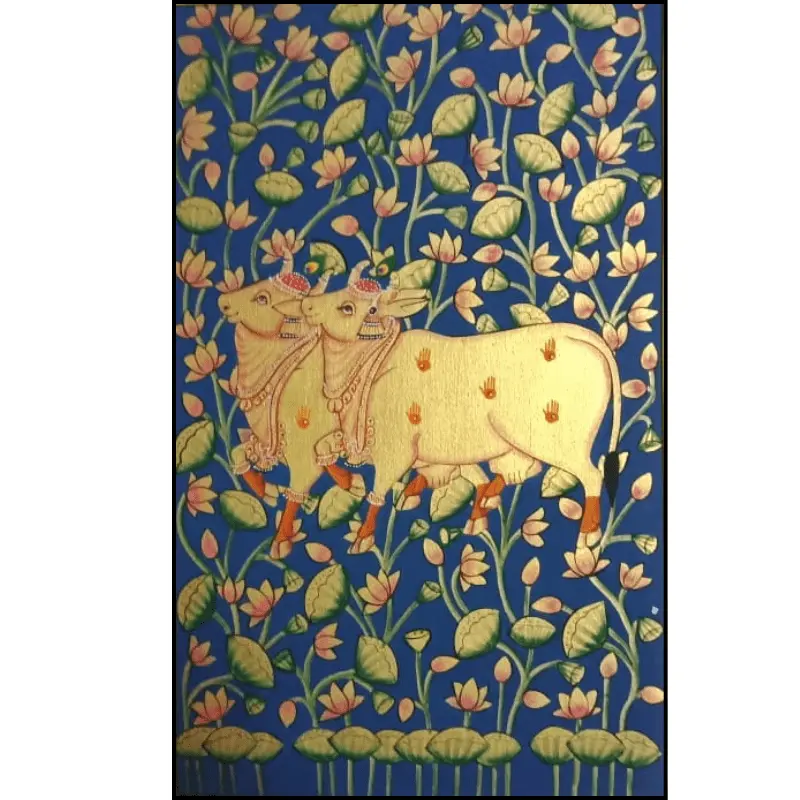
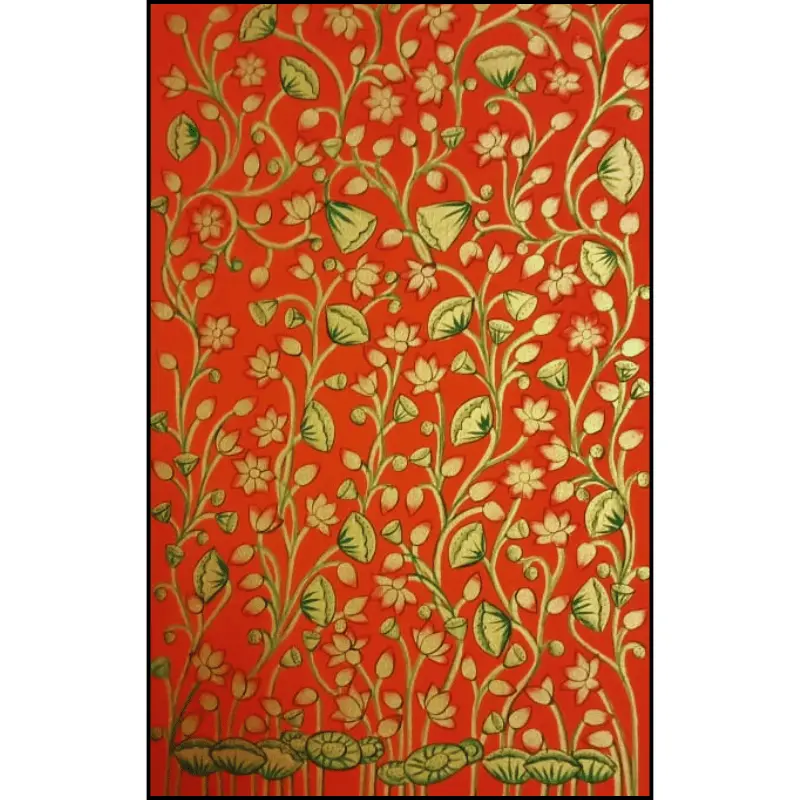
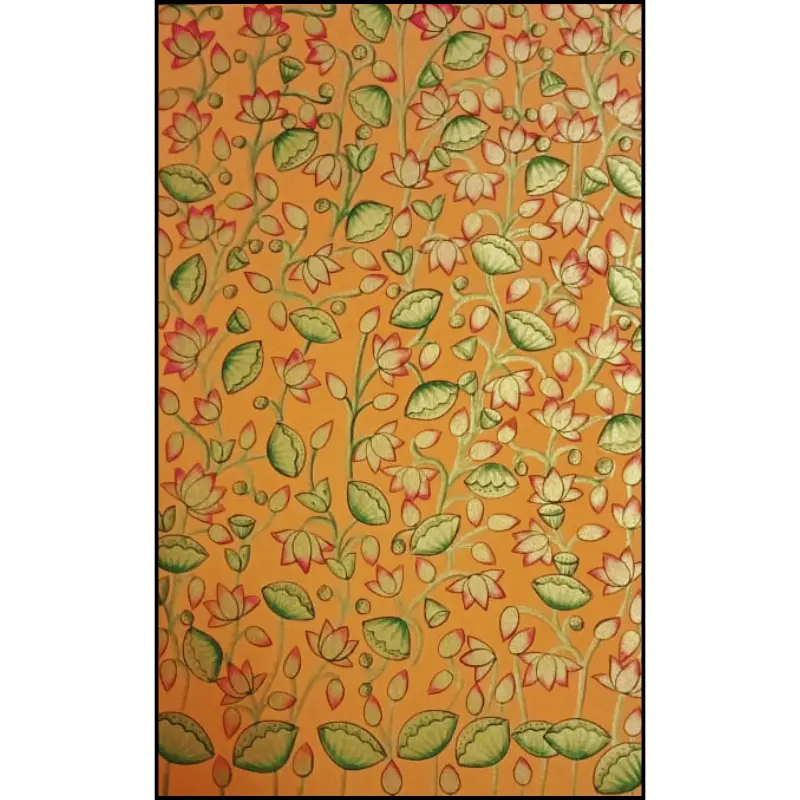
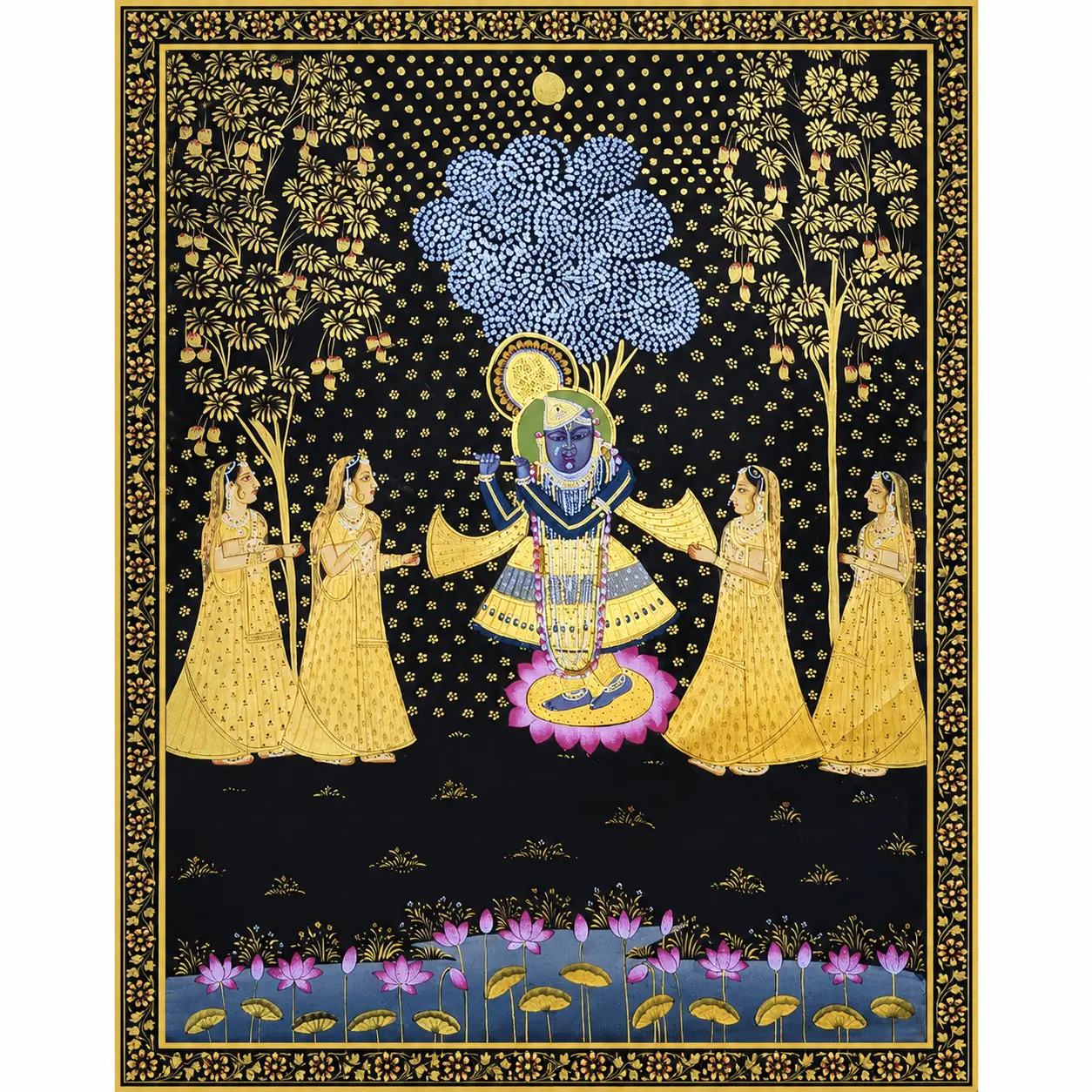
Buying a Pichwai painting is a meaningful purchase of Indian heritage. But the market is full of printed replicas sold as handmade art. This guide shows you how to identify an original Pichwai painting, so that you get true value and authenticity for your money. You will learn eight simple checks, the questions to ask a seller, and the warning signs to avoid.
Table of Contents
- Handmade vs print at a glance
- 8 checks to identify an original Pichwai painting
- Questions to ask the seller
- Red flags to avoid
- Where to buy an authentic handmade Pichwai
Handmade vs Print at a Glance
| Feature | Original handmade Pichwai | Printed replica |
|---|---|---|
| Detailing | Ultra-fine lines made with miniature brushes | Flat lines, little depth in shading |
| Texture | Visible brush strokes, slightly raised in places | Smooth, uniform surface |
| Colour | Natural pigments with a soft matte finish | Too perfect, overly smooth or glossy |
| Gold | Hand-applied gold foil that reflects unevenly | Metallic ink that looks flat and uniform |
| Proof | Artist details and Certificate of Authenticity | No artist name or papers |
| Price | Reflects weeks of handwork | Priced like a poster or canvas print |
8 Checks to Identify an Original Pichwai Painting
1. Check the detailing (hand vs print)
Original Pichwai paintings have ultra-fine detailing created using miniature brushes. Look at small areas such as jewellery outlines, lotus petals, cow ornaments and the leaves of a tree. In a handmade painting, these details are sharp, layered and slightly different from one another. Printed artworks look flat and lack depth in lines and shading.
2. Look for texture
A handmade Pichwai shows visible brush strokes and a slightly raised paint texture in places, especially in gold work, outlines and shading. If you can see the character of the brush and the layers of colour, that is a good sign. A print usually has one smooth, even surface from edge to edge.
3. Natural colours vs synthetic prints
Original Pichwai uses natural stone and plant pigments, which give a soft matte finish and a layered depth. Prints look too perfect and overly smooth, or have a glossy, plastic-like sheen. Colours in a print often look the same in every light, while natural pigments change gently as the light moves.
4. Gold foil detailing
Real Pichwai includes hand-applied gold foil detailing, often on crowns, jewellery, borders and highlights. Gold foil reflects light unevenly and has a slightly raised, tactile edge. Printed metallic ink looks uniformly flat and shiny. Tilt the painting or ask for a short video to see how the gold behaves under changing light.
5. The base material
A genuine Pichwai is painted on handspun cotton cloth, canvas or a wall panel, not on thin polyester fabric or paper. Cloth is the most traditional base, and canvas is the most practical for homes. Each base suits a different space, and you can read more in our guide on Pichwai painting on cloth vs canvas vs wall panel.
6. Artist signature and authenticity
Many professional artists sign their work or provide a Certificate of Authenticity, which helps verify originality. A genuine certificate carries the artist's name, painting title, materials, dimensions and date of completion. Genuine sellers can also name the artisan family or workshop that made the piece.
7. Price: handmade vs print
Original Pichwai paintings take weeks to create, so their value is significantly higher than printed versions. A single large painting can take 20 to 60 days, depending on size and detail. If a large, detailed painting is priced like a poster print, it is almost certainly a machine print. At Rupasya, handmade Pichwai paintings start from Rs 7,100 and go up to Rs 2,50,000, depending on size, gold foil work, base material and the complexity of the composition.
8. Ask for real photos and proof of the making
Ask for close-up photos of the actual painting, not only the product image. Look at the brushwork, gold and edges. A seller of handmade art will happily share details of the making, the artisan and the materials. Two listings of the "same design" that look mechanically identical down to every line suggest printing.
Questions to Ask the Seller
- Who painted this piece, and where was it made?
- Which pigments and which base material are used?
- Is the gold hand-applied foil or printed ink?
- Does the painting come with a Certificate of Authenticity?
- Can you share close-up photos or a short video of the actual painting?
- How is it packed and shipped, and what is the return policy?
Red Flags to Avoid
- An unusually low price for a large, detailed "handmade" painting.
- Only stock images and no close-ups of the real piece.
- No artist name and no certificate.
- A perfectly uniform, glossy surface with no brush strokes.
- Vague answers about materials, gold and how long the painting took.
Why Originality Matters
Pichwai is a 400-year-old art form from Nathdwara, Rajasthan, made as large cloth backdrops behind the idol of Shrinathji. When you buy an original, you support the artisan families who keep this craft alive, and you get a painting with the depth, detail and devotional feeling that a print cannot match. If you are new to the art, you can start with our guide to Shrinathji Pichwai painting.
Where to Buy an Authentic Handmade Pichwai
If you want a guaranteed handmade and original artwork, explore our Pichwai paintings collection. At Rupasya, every painting is 100% handmade by master artisans from Nathdwara and Udaipur using natural stone pigments and gold foil. We do not sell prints or reproductions, and every painting comes with a Certificate of Authenticity. If you want a special size, theme or colour, we also make custom Pichwai paintings, and we ship worldwide.
To see how themes differ before you buy, read our guides to lotus Pichwai painting and the cow painting guide.
Final Words
Understanding originality ensures you invest in real art, not a printed duplicate. Always buy Pichwai from trusted artists or verified platforms, ask for close-up proof, and compare the price with the effort that goes into a hand-painted piece. A little care before you buy will give you a painting you can enjoy and pass down for generations.
Frequently Asked Questions
How can I tell if a Pichwai painting is handmade or printed?
Look closely at the brushwork. A handmade Pichwai has fine, slightly varied lines, layered colour and a soft matte pigment texture. A print looks flat and uniform, and tiny dots may show under a magnifier. Gold foil in a handmade piece catches light unevenly, while printed gold looks the same from every angle.
How do I know if the gold in a Pichwai painting is real foil?
Real gold foil is applied by hand and reflects light unevenly as you move, with slightly raised, tactile edges. Printed metallic ink looks uniformly flat and shiny. Ask the seller to show the gold areas in a short video or angled photo, and ask whether the gold work is hand-applied foil or ink.
How long does it take to make an original Pichwai painting?
A large handmade Pichwai usually takes 20 to 60 days, depending on size, fine detailing and gold foil work. Artists prepare the base, sketch the composition, grind natural pigments and build the colours in layers. If a very large, detailed painting is offered within days at a low price, it is likely a print.
How much does an original handmade Pichwai painting cost?
Handmade Pichwai paintings at Rupasya start from Rs 7,100 and go up to Rs 2,50,000. The price depends mainly on size, gold foil detailing, base material and the complexity of the composition. A large, detailed painting priced like a poster, such as Rs 500 to Rs 1,000, is almost certainly a machine print.