The Story Behind Rajasthani Village Life Paintings
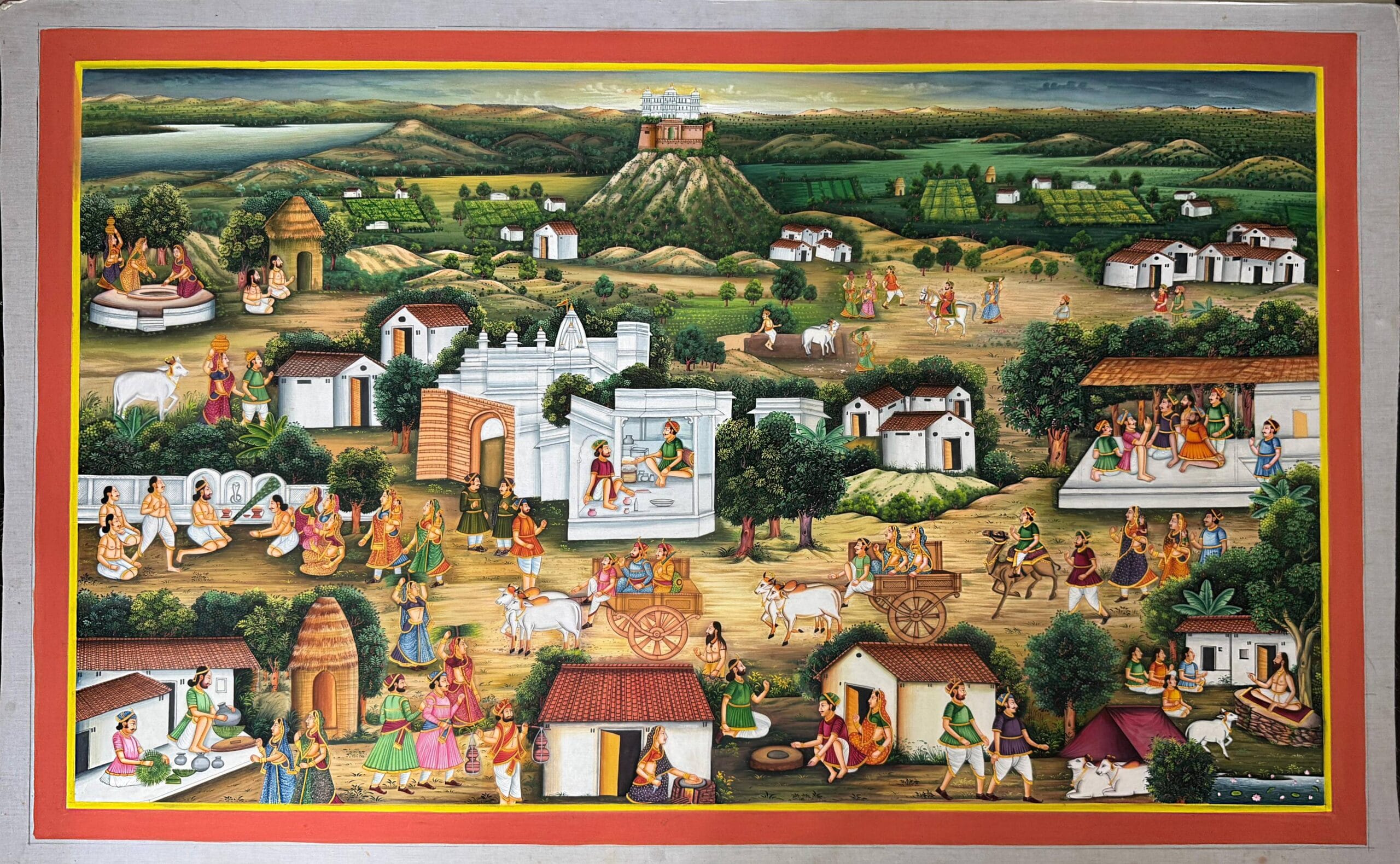
Picture a single canvas that somehow holds an entire village inside it — a fort watching over the land from a hilltop, women balancing pots on their way back from a well, farmers guiding bullock carts through the fields, a temple at the centre of it all, and dozens of small figures each caught mid-story. That's the magic of a Rajasthani village life scene painting, and once you understand where it comes from, it's easy to see why this art form has lasted for centuries.
A Tradition Born in Royal Courts
This style didn't start in villages — it started in palaces. Rajasthani miniature art took shape in the princely states of Rajasthan, developing between the 16th and 19th centuries, shaped by the region's royal traditions, religious devotion, and deep love for storytelling. Kings and nobles were the original patrons, commissioning artists to capture everything from battles to devotion to daily life.
What's interesting is that this style wasn't born out of Mughal influence, even though people often assume that. It actually grew out of earlier Western Indian manuscript painting traditions, with Mughal elements only entering the picture later on. The result is a style that feels unmistakably Indian at its core — bold colour, flat perspective, and figures full of expression — even where it later absorbed outside techniques
As the art form spread across the region, it split into distinct regional schools — Mewar, Bundi, Kota, Jaipur, Marwar, and others — each shaped by its own court, its own painters, and its own preferred subjects.
Why Artists Turned to Village Life
Court paintings usually leaned toward the grand — royal hunts, battles, mythology, romance between Radha and Krishna. But somewhere in that same tradition, artists also began turning their attention to something quieter: the everyday rhythm of village life.
Painters depicted village scenes, court scenes, forest scenes, and landscapes alongside their more formal work, often revealing the everyday social and cultural life of common people rather than only royalty. That's really what sets a village life painting apart — it's less about glorifying a king and more about honoring a whole community. One painting might hold a wedding procession, a potter shaping clay, children playing near cattle, and women drawing water — dozens of small moments that all belong to the same day, the same place
Certain schools, like Bundi, were particularly known for weaving daily life and seasonal festivals into their work, sitting comfortably alongside more courtly themes. It's this mix — grandeur next to simplicity — that gives these paintings their lasting charm.
The Craft Behind the Colour
Long before synthetic paints existed, artists were mixing their own. Natural colours were made from minerals, vegetables, and even precious stones, ground down and applied by hand. That's part of why authentic Rajasthani paintings still carry such rich, warm tones — reds, golds, greens — even generations after they were made.
And the detail is where the real skill shows. Every single figure, however small, is painted with a specific pose, task, and expression. Multiply that across an entire village scene, and you start to understand why a painting like this can take a master artist weeks, sometimes months, to finish.
Why This Art Still Matters Today
In a time when most décor is mass-produced, there's something different about owning a piece that was actually made by hand, using a technique passed down for generations. A Rajasthani village life painting isn't just something to look at — it's a small window into a way of life, a piece of history you can hang on your wall.
If this kind of art speaks to you, our Rajasthani Village Life Scene Painting is a large, hand-painted 48x72 inch piece made in this very tradition — a real, living example of the craft, not a print or reproduction.