What is Rajasthani miniature painting?
Rajasthani miniature painting is the small, finely detailed court art of the Rajput kingdoms of present-day Rajasthan, made mostly between the 17th and 19th centuries. It is often grouped with Pahari painting under the wider label of Rajput painting. Rajasthan already had its own painting tradition before Mughal influence arrived in the 16th century, and it is understood that artists trained in the Mughal manner later moved to Rajput courts and blended that training with local ways of painting.
Where Mughal painting grew from Persian models, Rajasthani painters leaned on the Ramayana, the Bhagavata Purana, love poetry, music and the lives of their own rulers. Each court then developed a house style, which is why a Mewar painting and a Kishangarh painting can look like they come from different worlds.
The main schools of Rajasthani miniature painting
Historians usually describe the tradition court by court. The table covers the three schools most often discussed, and a note on the others follows it.
| School | Where | What to look for |
|---|
| Mewar | Udaipur and the surrounding Mewar region | Bold primary colours and strong emotion. Early landmarks include the Chawand Ragamala of 1605 and the ragamalas and Rasikapriya folios of the artist Sahibdin. Later work moves toward court life and royal activity. |
| Bundi and Kota | South-eastern Rajasthan (the Hadoti region) | Lush vegetation, dramatic night skies, water drawn as light swirls on a dark ground, and tiger hunts in thick jungle. |
| Kishangarh | Central Rajasthan | Long, half-closed lotus-shaped eyes, arched brows and a pointed chin. Linked with the artist Nihal Chand and the famous Bani Thani portrait of the mid-18th century. |
Jaipur (Amber), Bikaner and Marwar (Jodhpur) are other major centres, and Bikaner in particular shows a strong Mughal influence. For deeper reading, Britannica's entry on Bundi painting and the Met Museum's page on the Mewar artist Sahibdin are reliable starting points. Rupasya's miniatures follow the Mewar tradition, because our artists work in Udaipur.
How to tell the schools apart in 60 seconds
These are tendencies, not strict rules. Artists moved between courts, styles overlapped, and Bundi and Kota work was hard to separate for a long time. Still, four quick checks get you a long way.
- Colour: bold primary colours and strong lines suggest Mewar.
- Sky and water: a dark, dramatic night sky, or water painted as pale swirls on a dark ground, points to Bundi or Kota.
- Faces: very long, half-closed lotus-shaped eyes, curved brows and a sharp chin point to Kishangarh.
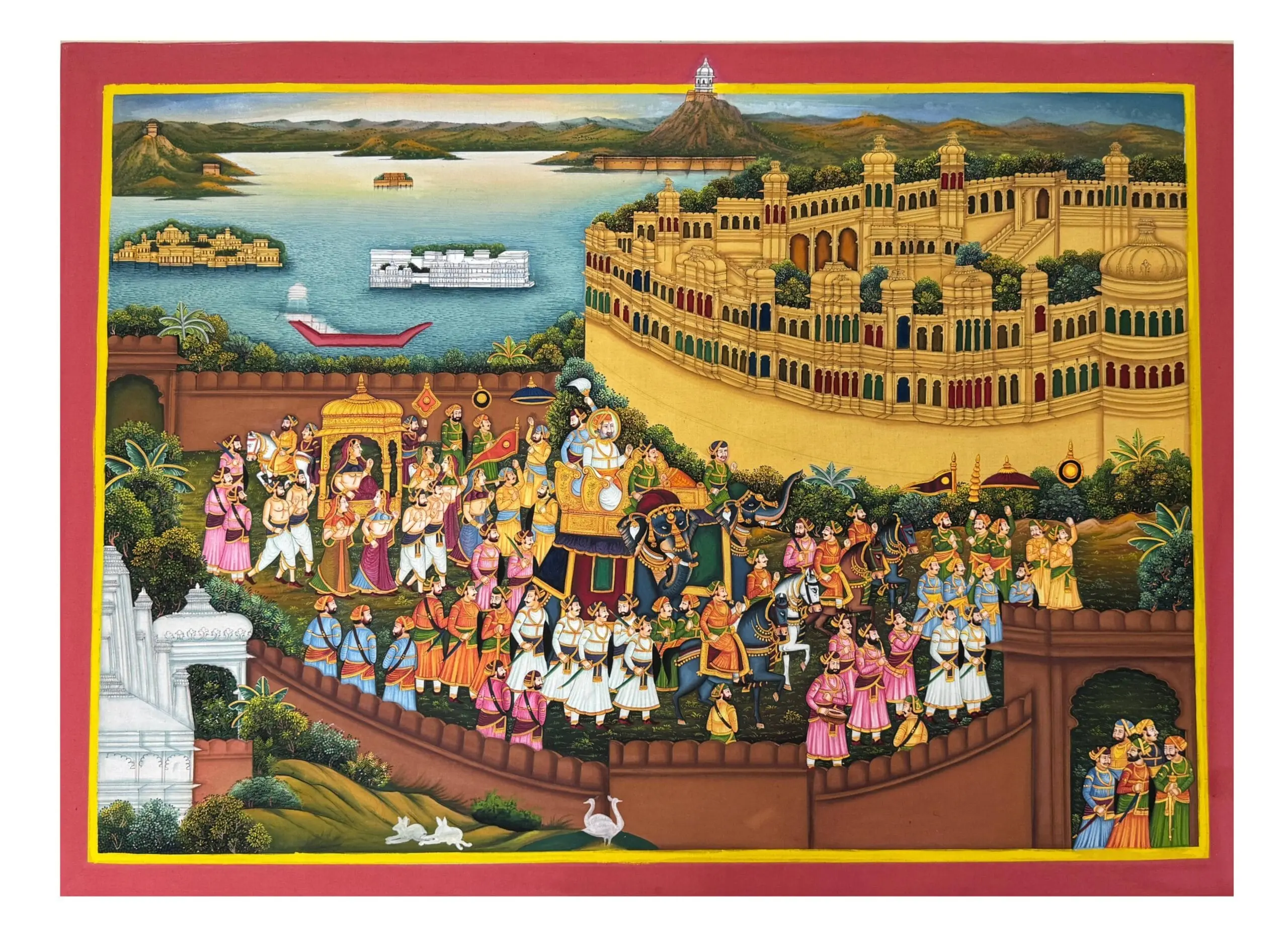
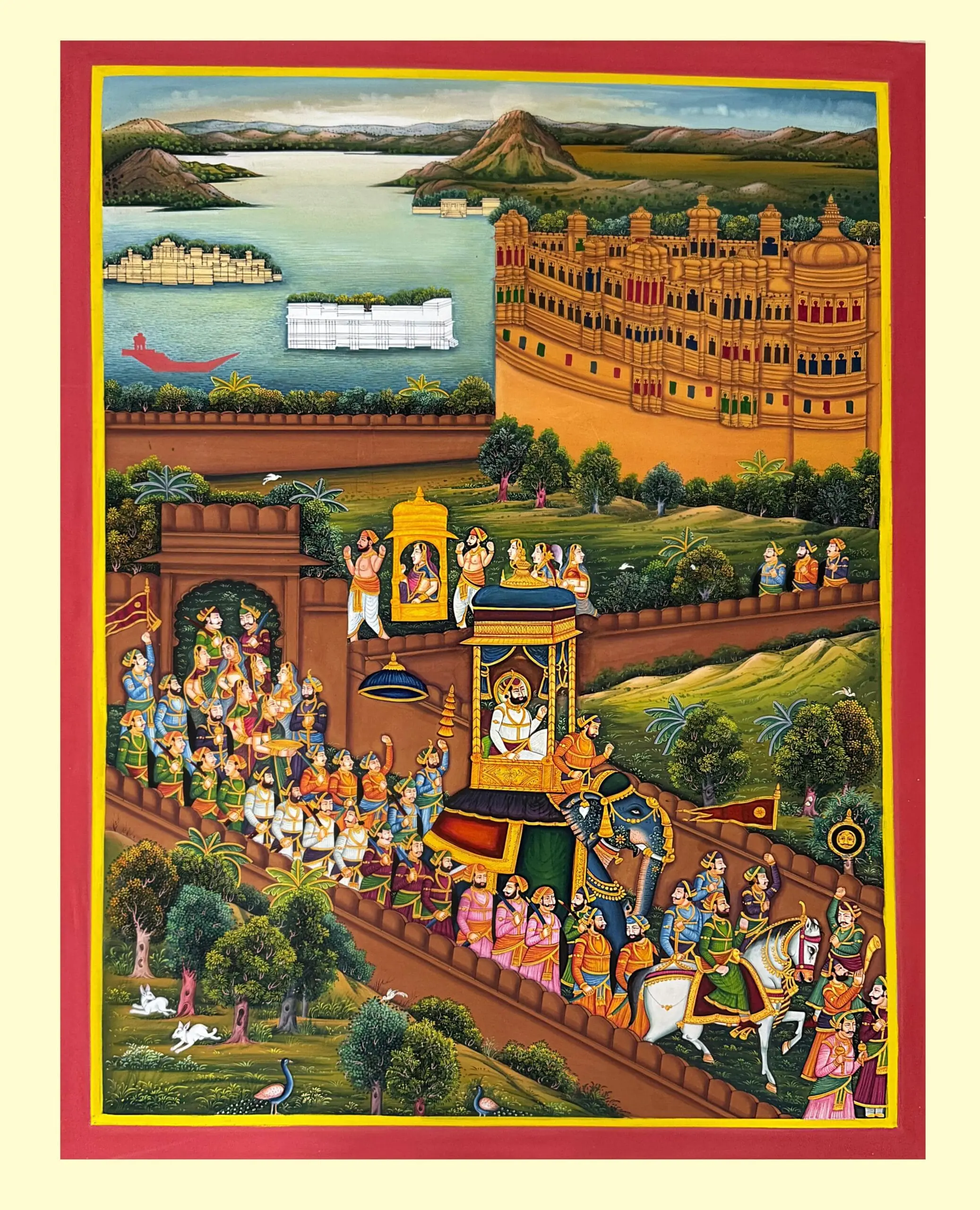
- Subject: a tiger hunt in dense, hilly jungle often points to Bundi or Kota, while a long royal procession is common in later Mewar painting.
Subjects Rajasthani painters kept returning to
Love, music and devotion
Ragamala sets turned the moods of Indian classical ragas into pictures, and the Rajput courts were among their most prominent patrons. In Rajput painting, romantic love and devotion to Krishna are often treated as close cousins. Mewar's Rasikapriya folios cast Krishna as the ideal lover, and Sahibdin's Gita Govinda illustrations place Krishna's romances in forests rich in leaf and flower detail.
Forests, hunts and hawking
Hunting was a courtly ritual as much as a sport, and painters at Kota and Bundi became known for tiger hunts full of movement. Our guide Forest, Hunt & Hawking: Decoding the Wild Landscapes of Rajasthan Miniature Painting explains how to read these scenes and what the forest says about the ruler who rides through it.
Royal processions and court life
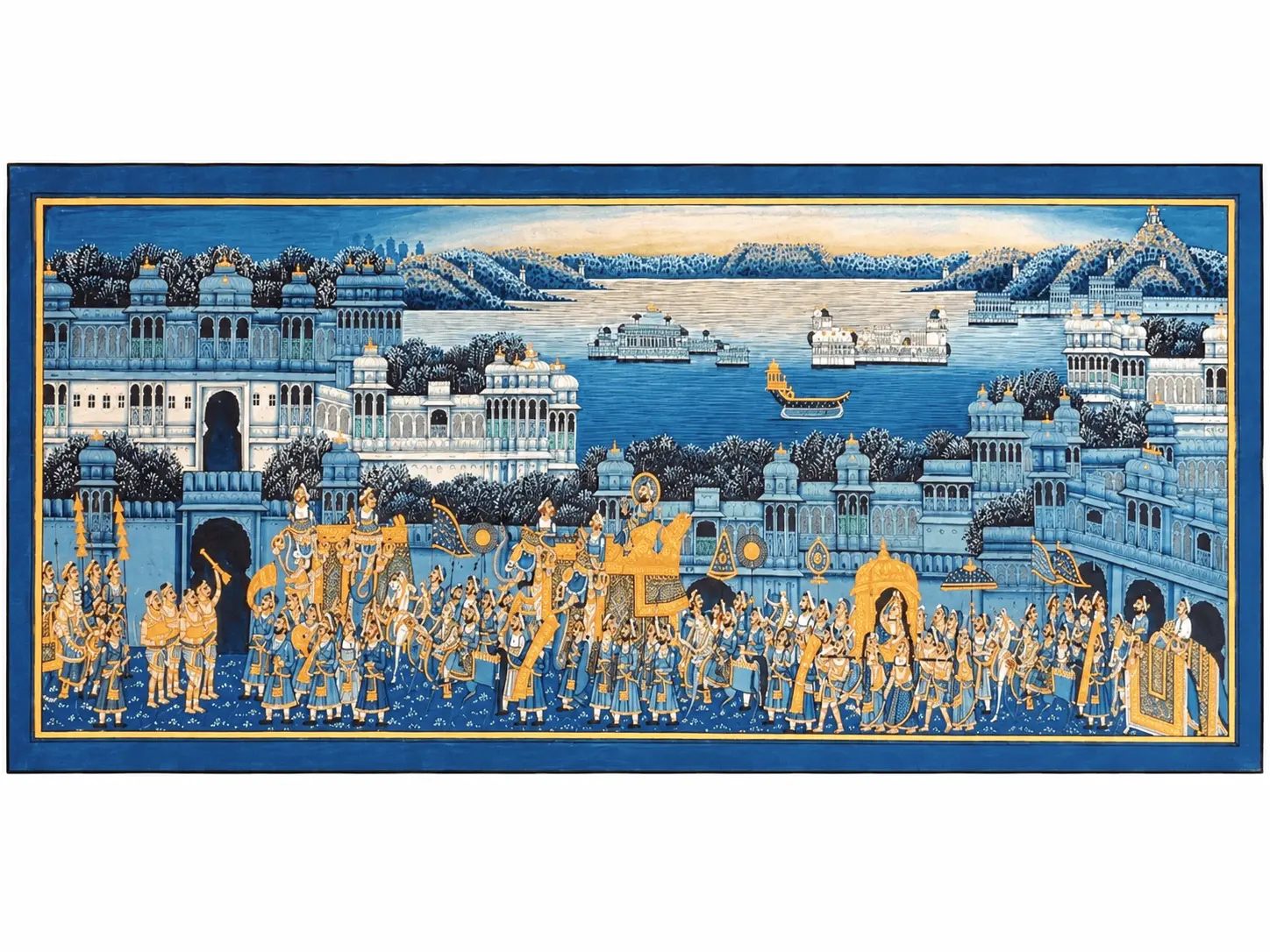
By the 18th century, Mewar painters had moved from illustrating texts toward scenes of royal activity such as court ceremonies, outings and processions. Painted in Procession: The Royal Court Scenes of Udaipur's Mewar Artists looks at how these panoramic scenes show a ruler at the height of his civic power.
Village and everyday life
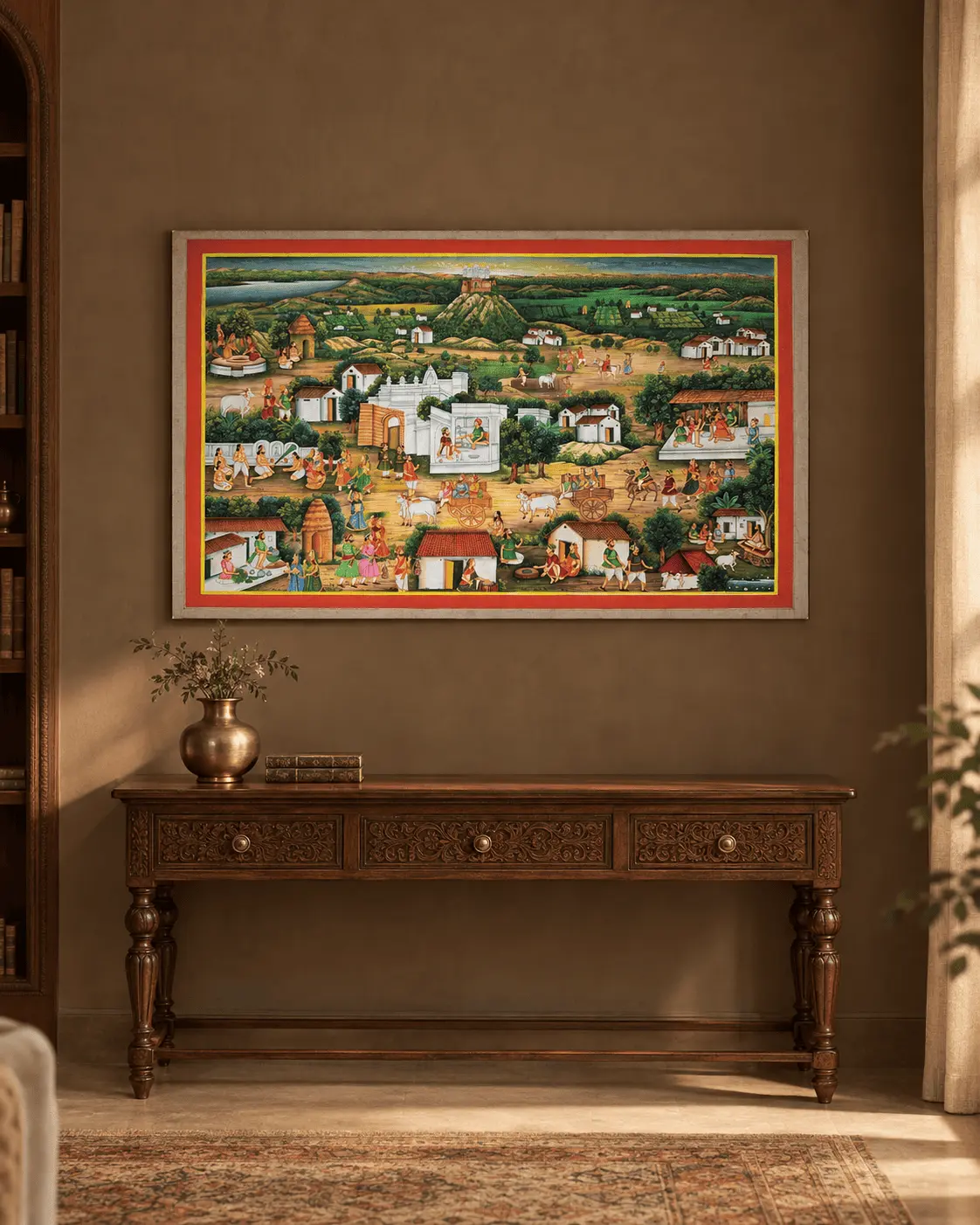
Not every miniature is about kings. Rajasthani Village Life Painting: History & Meaning shows how a single canvas can hold a hilltop fort, women carrying pots from the well and farmers guiding bullock carts through the fields.
Materials and technique
Traditional miniatures are painted on wasli, a handmade paper built up from thin layers pasted with starch and then burnished with a smooth stone until the surface is hard and even. Artists sketch first, lay down base colours and add the finest detail with squirrel-hair brushes. Colours were traditionally ground from minerals and plants and bound with gum, with gold and silver added for highlights. Rupasya's Rajasthani miniatures are painted by artists in Udaipur using this method. For a fuller walkthrough, read our complete guide to Indian miniature paintings.
Rajasthani or Mughal miniature?
The two traditions share techniques but not temperament. Mughal miniatures grew from Persian models and often record emperors, nobles and court life, while Rajasthani miniatures favour bold colour, Hindu epics, Krishna devotion, music and local rulers. If you are weighing both, view our Mughal miniature paintings alongside the Rajasthani collection.
Choosing a Rajasthani miniature for your home
Match the subject to the room and the wall. A forest or hunting scene gives a study or dining wall a dense, green focal point. A royal procession is usually painted in a wide, panoramic format and needs room to unfold. Village scenes suit living areas where you want a conversation piece. Our collection runs from 12x16 inch works to 48x72 inch pieces, so measure the wall first.
Browse handmade Rajasthani miniature paintings to see the current collection, or commission a custom miniature painting in your own size and theme.
Quick answers
Which Rajasthani school is the most famous?
It depends on the yardstick. Kishangarh's Bani Thani, attributed to Nihal Chand and painted around the mid-18th century, is probably the single most recognised image. Mewar is the usual starting point for the wider story, with dated works such as the Chawand Ragamala of 1605.
Is Rajasthani painting the same as Rajput painting?
Not exactly. Rajput painting is the broader term and usually includes both the Rajasthani schools and the Pahari schools of the hills.
Where can I see original Rajasthani miniatures?
Major museums hold them. The Met Museum and the Smithsonian's Freer Gallery of Art have Mewar folios, and the Salar Jung Museum in Hyderabad has a broad Rajasthani collection.