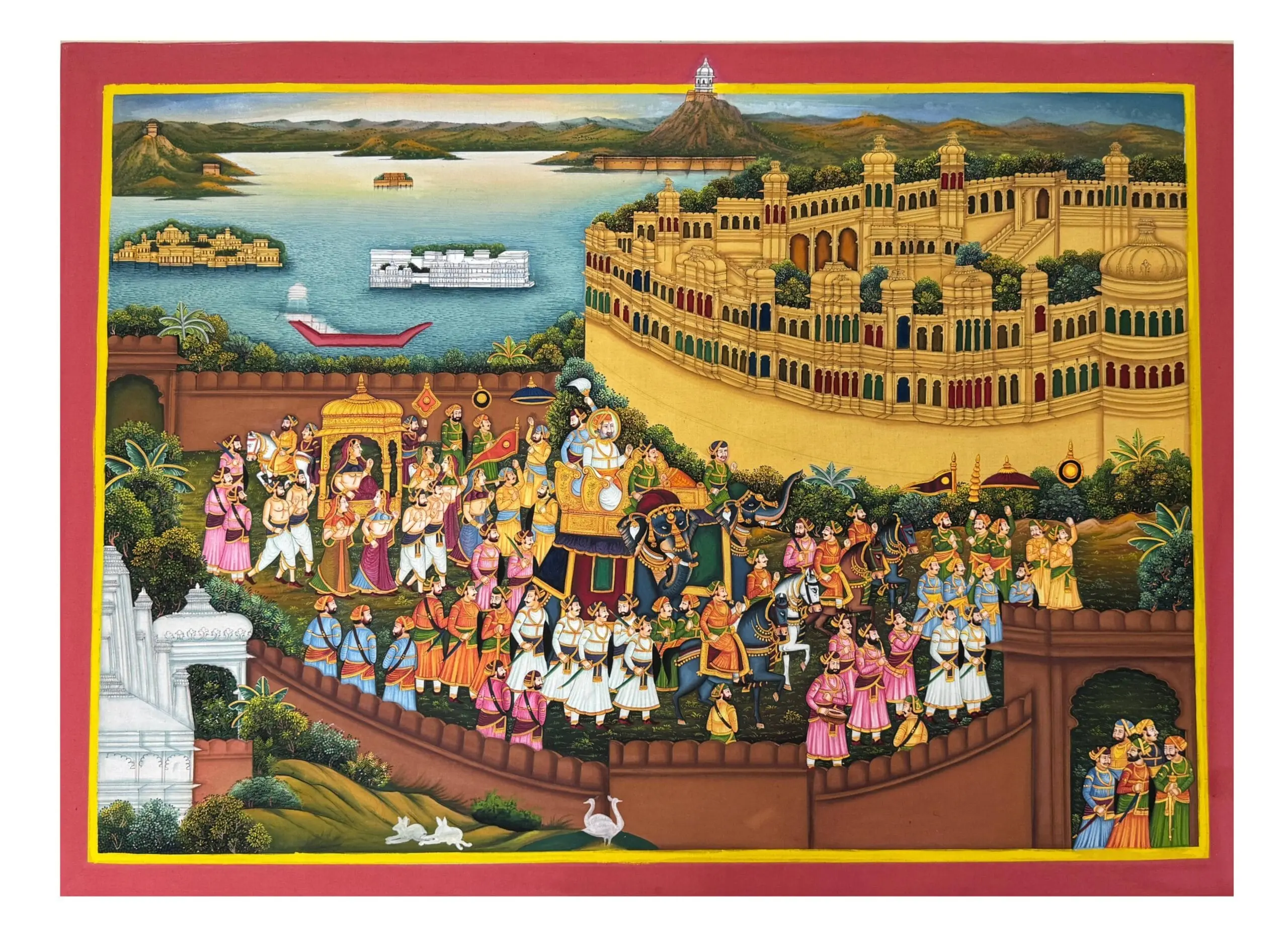
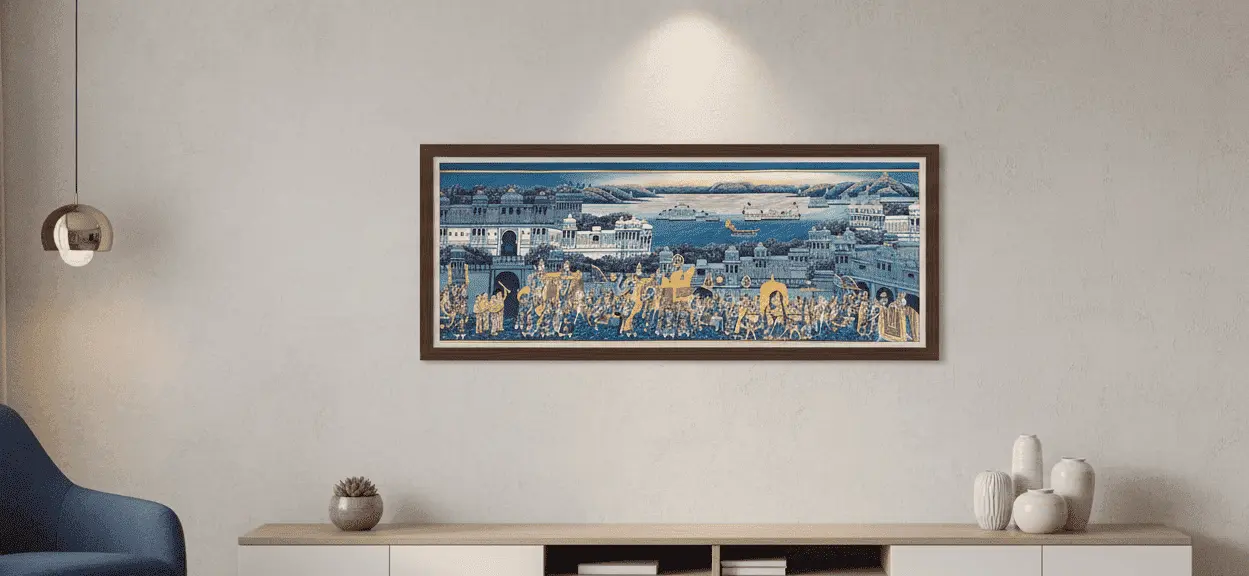
If forest scenes show a Rajput ruler proving himself against nature, royal procession paintings show him at the height of civic power — parading through his own city, surrounded by soldiers, musicians, and attendants, with the whole court watching. Of all the subjects in Rajasthan miniature painting, the royal procession is probably the most visually spectacular, and it's worth understanding what these paintings were actually documenting before you buy one.
What a Procession Painting Was Really For
Processions in Udaipur and other Mewar cities weren't casual events. They marked coronations, weddings, religious festivals, and military victories, and they followed set routes through the city — often passing the City Palace, temples, and the shores of Lake Pichola. A procession painting was the Rajput court's version of a state broadcast: it recorded who was present, what they wore, which animals and regalia were on display, and crucially, who rode closest to the Maharana.
Court painters attached to Udaipur's ateliers were sometimes sent along the actual procession route to sketch details on the spot, which they'd later work into a full composition back in the studio. That's part of why the best procession paintings feel so alive — the individual figures, however small, often have distinct postures and expressions rather than being interchangeable extras.
Reading the Composition
A classic Mewar procession painting is built almost like a parade route unrolled flat. The Maharana usually appears on an elephant or horse near the centre or front of the procession, identifiable by his size, his canopy or umbrella (a specific symbol of royal status), and the density of attendants around him. Behind and around him: soldiers with spears, standard-bearers carrying flags and insignia, musicians with drums and horns, and sometimes dancers or acrobats if the occasion was celebratory rather than military.
Architecture plays a bigger role here than in almost any other Rajasthani subject. Artists took real pride in rendering the City Palace's domes, chhatris, and jharokhas (the ornate overhanging balconies), often with more geometric precision than the human figures receive — because the palace itself was a symbol of dynastic permanence that the artist wanted future viewers to recognise immediately.
Why These Paintings Are So Labour-Intensive
A large-format procession scene is, subject for subject, one of the most demanding pieces a miniature artist can take on. Where a single portrait might involve one or two figures, a full procession can include dozens — each with individually painted clothing patterns, facial features, and weapons or instruments — all while maintaining the flat, decorative colour palette that defines the Mewar style. This is why our own procession paintings, some spanning up to 48x72 inches, can take our Udaipur artists several months from first sketch to finished, gold-detailed piece.
What Makes a Procession Painting Worth Owning
Beyond the historical interest, a well-executed procession painting has a kind of visual density that rewards long-term living with it — you notice a new figure, a new architectural detail, or a new piece of symbolism every time you look properly. That's different from most decorative art, which you tend to stop 'seeing' after a few weeks on the wall.
If you're considering a royal procession miniature painting for a formal living room, a study, or an office where it'll be seen and discussed often, it's worth asking the seller how many individual figures are in the composition, and whether the architectural elements are based on a real Udaipur landmark like the City Palace
or Lake Pichola — the better pieces usually are, because that specificity is part of what separates an authentic Mewar-tradition procession scene from a generic 'Indian palace' illustration.
In Rupasya's Rajasthan miniature painting collection, our procession pieces are painted by artists working in Udaipur itself, using the City Palace and its surrounding architecture as direct visual reference — the same landmarks the original 17th-century court painters would have looked at every day.
Frequently Asked Questions
What is a Mewar royal procession painting?
A Mewar royal procession painting is a miniature from the Udaipur court showing the Maharana and his retinue on parade, usually with elephants, horses, soldiers and musicians. Mewar artists were known for documenting court life, including processions, durbars and festivals, so these works served as a visual record of royal events as well as decoration.
How do you spot the Maharana in a procession painting?
Look for the largest figure, usually on an elephant or horse near the centre, with a ceremonial umbrella or canopy above him and the densest group of attendants around him. Artists used scale and position to show rank, so the people closest to the ruler are usually the most senior figures present.
Which Udaipur landmarks appear in these paintings?
The City Palace is the most common landmark. It was begun in the 16th century by Maharana Udai Singh II on the east bank of Lake Pichola, and painters often show its domes, chhatris and jharokhas. Using real architecture lets viewers recognise the setting as Udaipur straight away.
How long does a large procession miniature take to paint?
At Rupasya, large procession paintings can take several months from first sketch to finished piece, because every figure, costume, animal and architectural detail is painted by hand. Timing depends on the size and the number of figures, so ask for an estimate when you place a custom order.
What should I ask before buying a Mewar procession painting?
Ask how many figures are painted, whether the palace and lake are drawn from real Udaipur landmarks, which paper and pigments are used, and whether the work is signed by a named artist. Also confirm the exact size and whether it ships rolled or framed.