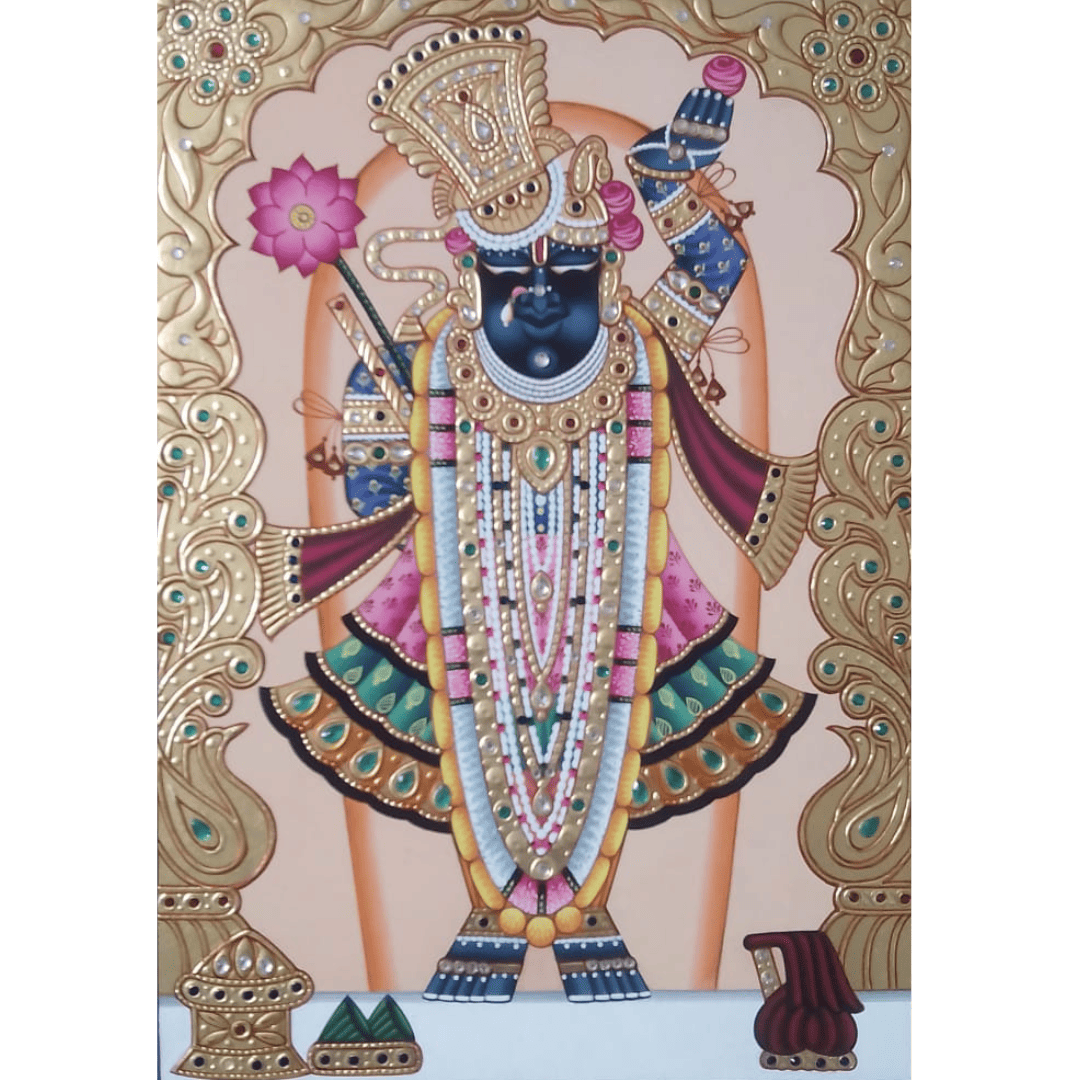
If you've ever come across a richly detailed painting of a dark-skinned deity draped in seasonal finery, surrounded by cows, lotus blooms, and gold-leaf borders, you've likely seen a Nathdwara painting. It's one of India's most distinctive devotional art traditions — but it's also one of the most misunderstood, often lumped together under the broad umbrella of "Indian devotional art" or confused with Tanjore painting from South India.
So what is Nathdwara painting, exactly? And what is Shrinathji Tanjore painting — is it even a real category, or a mix-up of two very different traditions? This guide walks through the history, origin, and living craft behind this 350-year-old art form, straight from the town where it all began.
What Nathdwara Painting Actually Is
Nathdwara painting is a devotional art style that originated in the town of Nathdwara, Rajasthan, centered entirely around depictions of Shrinathji — a childlike form of Krishna worshipped within the Pushtimarg tradition founded by Vallabhacharya. Unlike generic "Indian devotional art," which can span countless deities, regions, and styles, Nathdwara painting has one singular subject at its heart: the Swaroop (sacred image) of Shrinathji, shown with his left arm raised, dressed according to the season, festival, or time of day.
This is also where the confusion around "what is Shrinathji Tanjore painting" comes from. Tanjore painting is a distinct South Indian art form from Thanjavur, Tamil Nadu, known for its raised gesso work, gold foil, and gemstone inlays — traditionally depicting deities like Krishna, Ganesha, or Balaji. Over time, some artists have blended Tanjore's gold-relief techniques with Shrinathji as the subject, creating hybrid pieces sometimes marketed as "Shrinathji Tanjore paintings." But true Nathdwara painting is its own school entirely — rooted in Rajasthani miniature traditions, natural pigments, and a completely different visual language than Tanjore's gilded relief work.
1672 CE: The Installation of Shrinathji and the Birth of a Tradition
The story of Nathdwara painting begins with an act of devotion and protection. In the late 17th century, as concerns grew over the safety of the sacred Shrinathji idol in Mathura, the deity was moved for safekeeping. According to tradition, the idol's chariot became stuck near the banks of the Banas River in 1672, which was taken as a sign that Shrinathji wished to stay. A temple was built on that very spot, and the town that grew around it came to be called Nathdwara — literally, "the gateway of the Lord."
This moment marks the true origin of Nathdwara art. As the temple became the spiritual center of the Pushtimarg painting tradition, artists were drawn to Nathdwara to serve the deity in a very specific way — through paintings used as Pichwais (large cloth backdrops hung behind the idol) and smaller devotional portraits depicting Shrinathji's daily rituals, seasonal attire, and festival celebrations. Painting wasn't a side art form here; it was — and remains — an act of worship in itself, developed hand-in-hand with temple ritual for over 350 years.
Who Are the Chitrakar Artists?
At the heart of nathdwara painting history are the Chitrakar artists — a hereditary community of painters who have passed the craft down through generations, often father to son, within the same families for centuries. The word "Chitrakar" literally means "picture maker," and in Nathdwara, this title carries deep weight: these artists trained not in art schools, but in home workshops, learning brush control, pigment mixing, and iconographic precision from childhood.
Because Shrinathji's form must follow strict iconographic rules — the tilt of the head, the raised arm, the specific ornamentation — Chitrakar training has historically emphasized discipline and repetition as much as creativity. A young apprentice might spend years perfecting borders and backgrounds before being permitted to paint the deity's face. This hereditary transmission is a defining feature that separates authentic Nathdwara painting from mass-produced devotional prints: every genuine piece carries the technique of a lineage, not just an individual artist.
Today, a shrinking number of Chitrakar families continue to practice traditional Nathdwara painting techniques, working largely by hand in a market increasingly dominated by printed reproductions.
Materials: What Makes a Nathdwara Painting Authentic
Traditional Nathdwara paintings are built from entirely natural materials, a big part of what makes them collectible and distinct from modern devotional prints:
• Stone and mineral pigments — hand-ground from natural stones, ochres, and minerals rather than synthetic paints, giving the colors a distinctive depth and longevity
• Handmade paper or cloth — often prepared with a base coat and burnished for smoothness before painting begins
• Squirrel-hair brushes — remarkably fine brushes, sometimes just a few hairs wide, used for the intricate detailing in jewelry, fabric patterns, and facial features
• Gold and silver detailing — used sparingly and precisely, particularly in Shringar (adornment) scenes
The combination of natural pigments and fine brushwork is what gives authentic hand painted devotional art from Rajasthan its characteristic richness — colors that don't fade the way printed inks do, and linework with a texture no machine reproduction can replicate.
Why Nathdwara Painting Matters Today
For collectors, Nathdwara paintings represent a living connection to one of India's oldest continuously practiced devotional art traditions — each piece a record of technique passed through generations of Chitrakar families, not a factory print.
For devotees, these paintings serve a practical and spiritual purpose: a hand-painted Swaroop of Shrinathji is a popular centerpiece for home temples, allowing the same seasonal and festival-based devotion practiced at the Nathdwara temple to be observed at home.
And for gift-givers, a Nathdwara painting carries meaning that mass-produced décor simply can't — it's a piece of Rajasthan's artistic and spiritual heritage, suited for housewarmings, weddings, or milestone celebrations where a meaningful, lasting gift matters more than a decorative one.
Bring Home a Piece of This Tradition
Whether you're drawn to the history, the craftsmanship, or the devotional significance, an authentic Nathdwara painting connects you directly to 350 years of the Pushtimarg painting tradition and the Chitrakar hands that keep it alive.
Explore our curated collection of hand-painted Nathdwara paintings, browse our dedicated Shrinathji paintings collection, or reach out to commission a custom Swaroop painting tailored to your home temple.
Have a specific size, season, or Swaroop in mind? WhatsApp us at +91 70731 09753 or email contact@rupasya.com to discuss a custom commission with our artists.