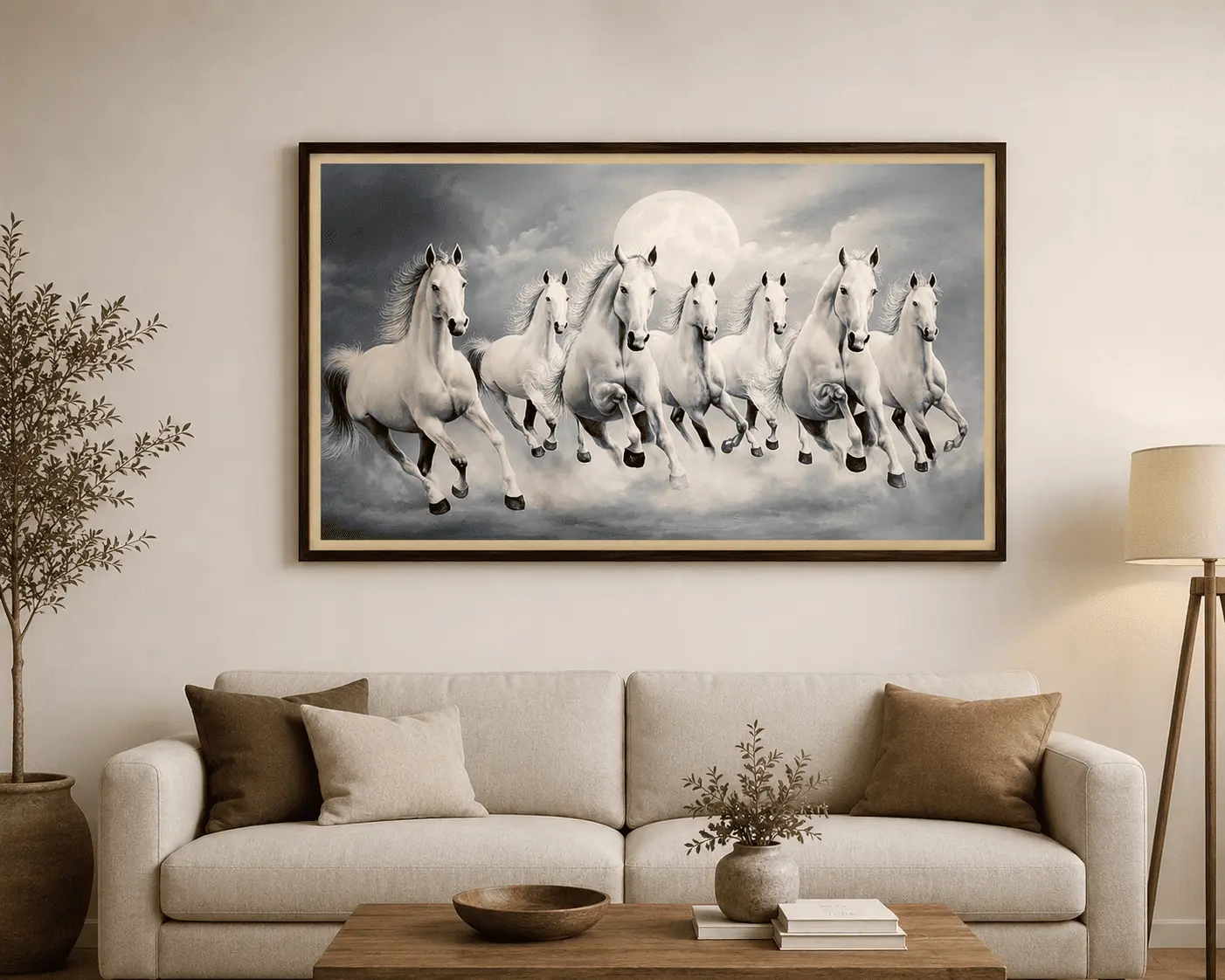
A 7 horse painting Vastu guide is usually one of the first things Indian homeowners look for before they buy, and the advice online contradicts itself. One page says south wall, another says east. One allows a bedroom, another forbids it. This guide sets out what most Vastu guides agree on, where they differ, and which parts are tradition and which are modern practice, so you can decide with clear eyes.
The short version:
- The horses should appear to run into the room, never out of it or towards a door or window.
- The south wall is the most commonly recommended. North and east are also widely accepted.
- The living room and an office or reception are the most suggested places.
- Avoid the wall opposite the main entrance, west or south-west walls, and walls next to a bathroom or toilet.
- Choose a handmade painting with calm, confident horses and all seven clearly visible.
What is 7 horse painting Vastu?
7 horse painting Vastu is the popular practice of hanging a painting of seven galloping horses on a chosen wall of a home or workplace, in the belief that it brings energy, success and forward movement. The imagery comes from Hindu tradition, and the placement rules come from modern Vastu advice. Vastu is the traditional Indian approach to arranging buildings and rooms by direction, and people use it in different ways, from strict followers to those who simply like a starting point.
You do not have to follow every rule to enjoy the painting. Many buyers use the advice as a practical guide to a good wall, a good room and a balanced size, and treat the rest as personal belief.
What do the seven horses stand for?
The seven horses come from Hindu iconography. The sun god Surya rides a chariot pulled by seven horses. The Salar Jung Museum's record of a standing Surya describes the horses as named after Sanskrit poetic metres (chandas), among them Gayatri and Brihati. They are commonly said to represent the seven days of the week and the seven colours of the rainbow. Because the chariot never stops, seven galloping horses came to suggest speed, strength and progress.
It is worth separating two things. The chariot and its horses are old and well documented in Hindu art. Hanging a painting of them to bring energy into a home is a modern, popular Vastu practice. The guides we read, including ours, do not cite a classical Vastu text for it. That does not make it meaningless to the people who follow it, but it does mean the finer rules vary from guide to guide, as you will see below.
Which direction should the horses face in the painting?
The point almost every guide agrees on: the horses should be running into the room, towards the centre of the space, not towards a window, a door or a wall. The belief is that horses facing inward bring energy and momentum into the room, while horses facing outward carry it away.
Guides disagree on whether the horses should run left or right across the frame. Some say they should run from right to left, as the sun appears to travel from east to west. Others say horses running to the right bring progress. Do not let this decide your purchase. Check how the painting will look in your room, and make sure the horses seem to move towards the centre of it.
Which wall is best for a 7 horse painting in Vastu?
Most guides name the south wall first. North and east follow. Here is how they are commonly described. The meaning of each wall varies between sources, so treat the table as a summary of popular views, not a rule.
| Wall | Commonly linked to | Notes |
|---|---|---|
| South | Fame, recognition, career growth | The most recommended wall in nearly every guide, for homes and offices |
| North | Prosperity and financial opportunity | Often suggested for home offices and rooms where money matters are handled |
| East | New beginnings, health, career or family harmony, depending on the guide | A good alternative when the south wall has a door or window |
| West and south-west | Generally advised against | Said to be linked to stagnant energy |
If the south wall is not available, the east or north wall is the usual fallback. Do not rearrange a room around the painting. Pick the best available wall from this list, and make sure the painting suits that room.
What if you cannot use the south wall?
Most homes do not offer the perfect wall, and that is fine. A simple order that most guides support is south first, then east, then north. Look at the walls of your living room or office in that order and choose the first one that is a solid, uninterrupted wall you can see from where people sit.
If the only free wall is west or south-west, or sits opposite the main door, it is better to choose another room or wall than to force it. In an open-plan home, any wall from the preferred directions that faces the seating area will do. For a specific floor plan, a Vastu consultant you trust can look at the actual layout, which no general guide can do.
Walls and places to avoid
- The wall directly opposite the main entrance. It is said to push energy straight back out of the home.
- West and south-west walls, as above.
- Walls next to a bathroom or toilet.
- A puja room. Several guides keep the painting out of it.
Which background and colours work best?
This is where guides disagree most, so here is what is widely repeated, and where sources split.
| Feature | What guides commonly say |
|---|---|
| Sunrise or bright daytime sky | Widely seen as the most auspicious background, linked to new beginnings and energy |
| Sunset | Guides split. Some advise against sunset scenes. Others set no rule |
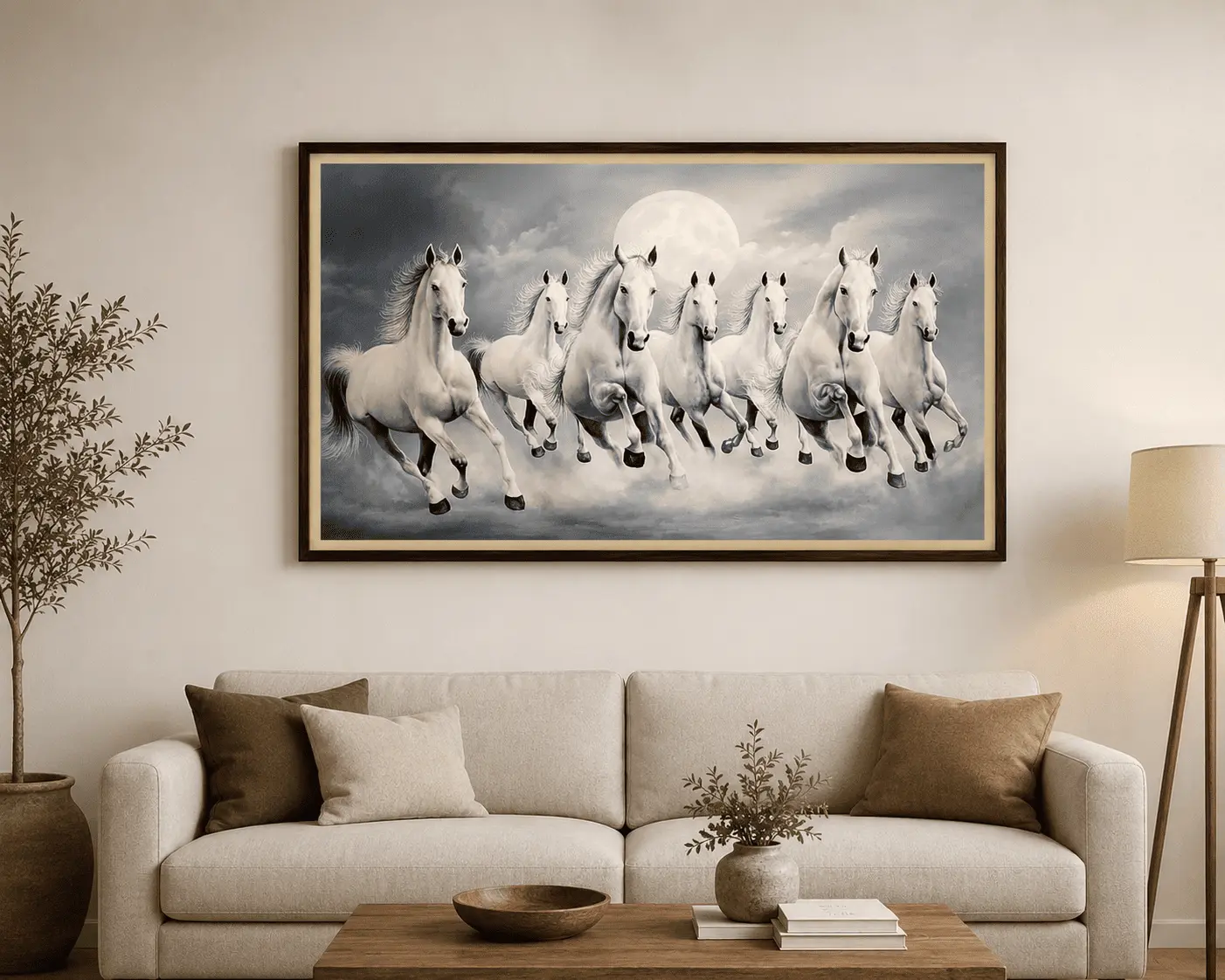
| Moonlit, white horses | Linked to calm and peace. Placement advice varies: some suggest north or east, one guide suggests north-west |
| Dark, stormy or gloomy scenes | Advised against by most guides |
| Horse colour | White is often linked to peace. Brown, black, red or golden tones each get different meanings in different guides |
Many paintings, including ours, use several tones in one composition. A mix of tones is generally seen as fine. If a particular background matters to you, choose a painting that shows it clearly, and check our guide to the three main styles of 7 horse painting to match the style to your room.
Which room is best?
Living room
The living room is the most commonly recommended room. Family gathers there and guests are received, so the painting is seen by everyone. Place it on the south wall if you can, at eye level, with the horses running into the room.
Office, reception or shop
Offices and reception areas are also widely recommended, usually on the south wall, facing inward. Many business owners hang a large painting in reception as a statement of ambition. Some guides say it helps a shop attract customers. That is a belief, not a guaranteed result.
Study room
Guides disagree. A home office or cabin is usually fine. A few guides advise against hanging it in a student's study room near the desk. If in doubt, choose the living room or office.
Bedroom
Several guides advise against it, because galloping horses can feel too active for a room meant for rest. Others accept it if the only available wall faces east. If you do choose a bedroom, the calmer moonlit style is the safer option, and it is best to keep the living room or office as the main location.
How many horses, and should they be running?
Seven is the traditional number, tied to Surya's chariot. Guides differ on other counts. Some prefer any odd number over a single horse, while others say single horses, pairs and groups all work. Whatever the count, guides agree on the condition of the horses: choose a painting where every horse is clearly visible, with calm and confident expressions, and avoid images that show ropes, chains, injured horses or aggressive faces.
Running or galloping horses are the usual recommendation, because their motion stands for progress. A standing horse is generally treated as neutral rather than negative.
Does a 7 horse painting have to be handmade?
Vastu texts do not specify a medium. Many practitioners, however, say an original handmade painting carries more life than a machine print, and that is the advice you will see on many sites. It is a matter of belief, not something that can be measured.
There is also a practical difference. Real oil paint has depth, texture and visible brushwork that a print cannot copy, and a hand-painted canvas is one of a kind. If you want to be sure you are buying a real one, read our buyer's guide to original oil paintings in India. To see how oil compares with other media for this subject, read 7 Horses Oil Painting vs. Other Mediums and our guide to oil painting vs acrylic.
7 horse paintings for offices, villas and hotels
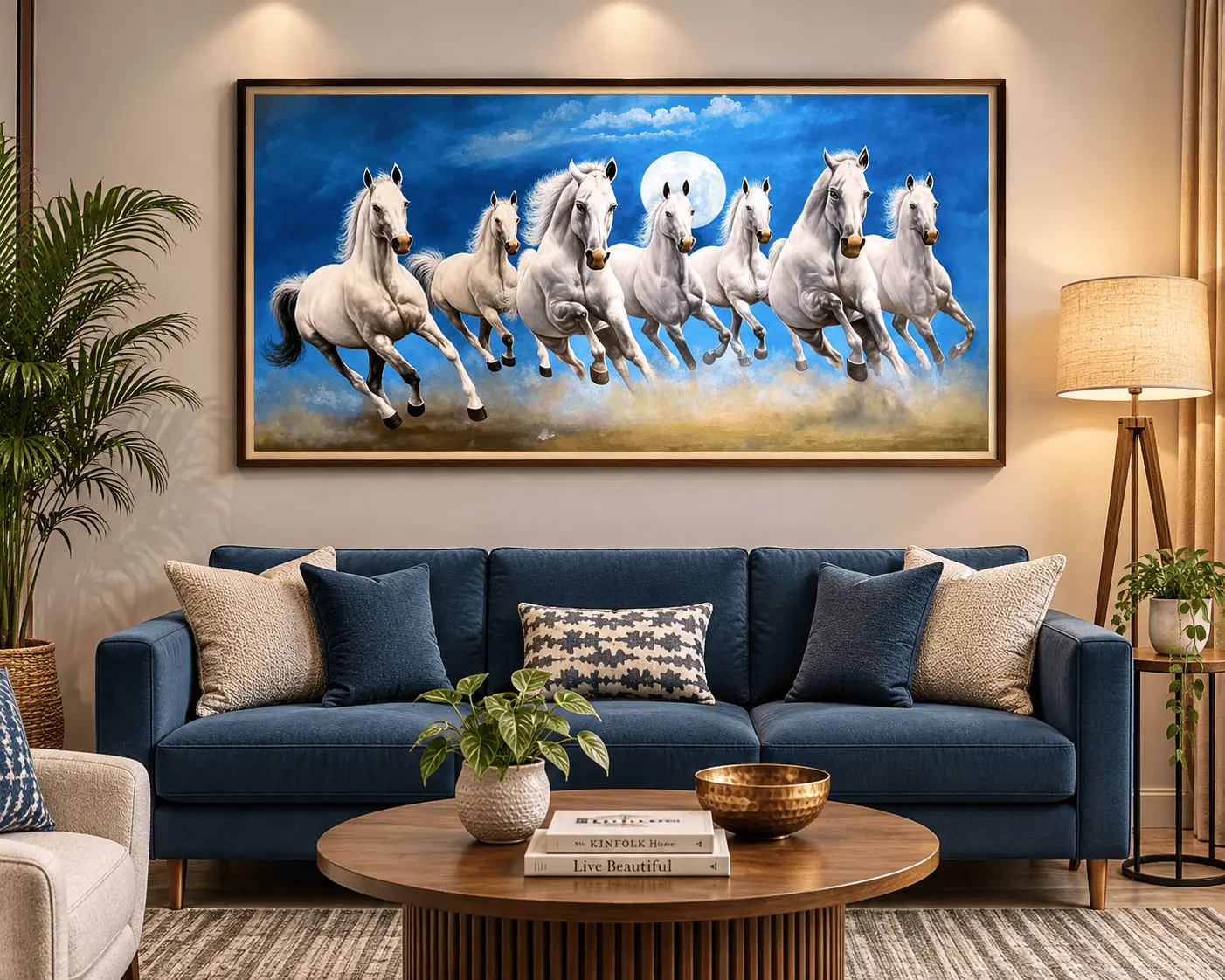
A reception wall or a villa's double-height living room can take a much larger painting than a flat can. That is where a large size, such as the 55 x 32 inch size of our golden sunset painting, makes sense, and where custom sizes help. In an office, the south wall of the cabin or reception is the most commonly suggested, with the horses running into the room. Keep the surrounding wall simple and well lit so the painting is the focal point.
If you want seven horses painted directly onto a wall rather than on canvas, we also offer mural art services in India.
Size and hanging: getting the basics right
- Size: aim for about two thirds of the width of the furniture below the painting. For a six-foot sofa that is about 48 inches. Our guide to choosing a 7 horse painting has a size table.
- Height: hang the centre of the painting at about 57 inches (145 cm) from the floor, roughly eye level, with about 6 to 8 inches above a sofa or console.
- Light: use soft, indirect light. Avoid spotlights close to the canvas, because the Canadian Conservation Institute warns that lights aimed at a painting can create damaging hot spots, and keep direct sunlight off it. See its guide to the basic care of paintings.
- Location: avoid damp walls, bathrooms, and air coming straight from an air-conditioner vent, which can harm oil paint over time.
- Surroundings: many Vastu guides prefer a clean, uncluttered wall around the painting. It also simply looks better.
How to hang it, step by step
- Measure the furniture below the wall and work out about two thirds of its width.
- Mark the painting's outline on the wall with painter's tape, and step back to check the size.
- Mark the centre at about 57 inches from the floor, or about 6 to 8 inches above a sofa.
- Use two hooks if the frame allows. The Canadian Conservation Institute notes that two hooks make it easier to keep a painting straight and level, and they are gentler on the wall than nails.
- Step back and check that the horses seem to run into the room, not out of it.
Caring for your painting
An oil painting lasts longest when it stays out of direct sunlight, away from damp walls and in steady humidity. Do not touch the paint surface or press on the back of the canvas. Dust gently with a soft dry brush, never use water or cleaners, and leave deeper cleaning to a professional conservator.
Three common confusions
- "Vastu texts prescribe a 7 horse painting." The guides we read cite no classical Vastu text for it. The horses come from Surya's chariot in Hindu tradition, and the placement advice is modern practice.
- "It only works on the south wall." South is the most recommended, but north and east are widely accepted too. Choose the best available wall.
- "A bigger painting is more powerful." No guide says size changes the effect. Choose the size that suits the wall, so the painting looks balanced.
A quick checklist before you buy
- Choose the wall: south if you can, otherwise north or east, and not opposite the main entrance.
- Check that the horses run into the room from where it will hang.
- Pick a bright, calm scene. Avoid stormy or gloomy backgrounds.
- Check that all seven horses are clearly visible and look calm and confident.
- Confirm it is hand-painted, and ask for close-up photos of the brushwork.
- Measure the furniture and size the painting to about two thirds of its width.
See the paintings
Our 7 horse paintings are hand-painted in oil on canvas by Udaipur artists. We offer a moonlit white horses painting, a daytime running horses painting and a large golden sunset painting. You can see them all in the 7 horse Vastu painting collection.
If your wall needs a particular size, use our custom painting commission page. More guides on oil paintings are in our Oil Paintings knowledge hub.
Frequently Asked Questions
Which direction should the horses face in a 7 horse painting?
The horses should run into the room, towards its centre, and never towards a door, window or wall. Guides agree on this far more than on anything else. They disagree on whether the horses should run left or right across the frame, so choose a painting that looks right in your room and moves inward from where it hangs.
Which wall is best for a 7 horse painting according to Vastu?
Most Vastu guides recommend the south wall, linked to fame, recognition and career growth. North and east are also commonly suggested, with north tied to prosperity. West and south-west walls, and any wall directly opposite the main entrance, are generally advised against. These are popular beliefs and the finer details differ between guides.
Can I keep a 7 horse painting in the bedroom?
Guides disagree. Several advise against it because galloping horses can feel too active for a room meant for rest, while others accept it on an east wall. If you choose a bedroom, the calmer moonlit style is the safer option. The living room or an office is the more commonly recommended place.
Does the background of a 7 horse painting matter?
Many guides prefer a bright sunrise or daytime sky and advise against dark, stormy or gloomy scenes. They disagree about sunsets: some advise against them, others set no rule. Moonlit white horses are linked to calm. If the background matters to you, ask the seller which time of day the painting shows before buying.
How many horses should a Vastu painting have?
Seven is the traditional number, because Surya's chariot is pulled by seven horses. Some guides prefer odd numbers over a single horse, while others accept any number. Whatever the count, choose a painting where all the horses are clearly visible, calm and confident, with no ropes, chains or injured horses.
Does a 7 horse painting have to be handmade?
Vastu texts do not name a medium, but many practitioners prefer an original handmade painting over a machine print. This is a matter of belief, not something measurable. A hand-painted oil also has real texture, depth and brushwork that a print cannot copy, so it is the better long-term choice either way.