Sharad Purnima is one of the most special nights in the Hindu calendar. Over time, this night became a favourite theme for Pichwai painting too, and a Sharad Purnima Pichwai painting is now one of the most loved festival themes from Nathdwara. In this blog, we explain what Sharad Purnima is, why people celebrate it, and how it turned into a beautiful Pichwai painting theme.
What Is Sharad Purnima?
Sharad Purnima is the full moon night that comes in the Hindu month of Ashwin, usually in September or October. "Sharad" means autumn season, and "Purnima" means full moon night. This night comes right after the monsoon ends, so it is also seen as the start of the harvest season.
The sky is usually clearer at this time of year, and the moon looks especially bright. This is one reason why the night has been admired and celebrated for so long.
Why Is Sharad Purnima Celebrated?
Sharad Purnima is celebrated for a few main reasons:
- The full moon: People believe the moon is fully complete on this night, with all its 16 phases. Its light is believed to be healing, so many people keep kheer (a sweet milk dish) under the moonlight and eat it the next day.
- Goddess Lakshmi's visit: It is believed to be the night when Goddess Lakshmi visits earth to bless people who stay awake. That is why it is also called Kojagari Purnima.
- Krishna's Raas Leela: In North India, especially in places like Vrindavan, Mathura, and Nathdwara, this night is remembered as the night of Krishna's Raas Leela, a divine dance between Krishna and the gopis (his devotees) under the full moon.
Customs differ by region and family, so people celebrate the night in their own way, with prayers, music, fasting, food offerings or simply time together under the moon.
Since When Is Sharad Purnima Celebrated?
Sharad Purnima is a very old festival. It is mentioned in ancient Hindu texts like the Brahma Purana, Skanda Purana, and Linga Purana. So this is not a new tradition. People have been celebrating this full moon night for many centuries, in almost every part of India, just with slightly different names and customs.
What Is a Sharad Purnima Pichwai Painting?
Pichwai painting itself started over 400 years ago in Nathdwara, Rajasthan. These paintings were made as large cloth backdrops for the shrine of Shrinathji (a form of Krishna) and were changed with the seasons and festivals.
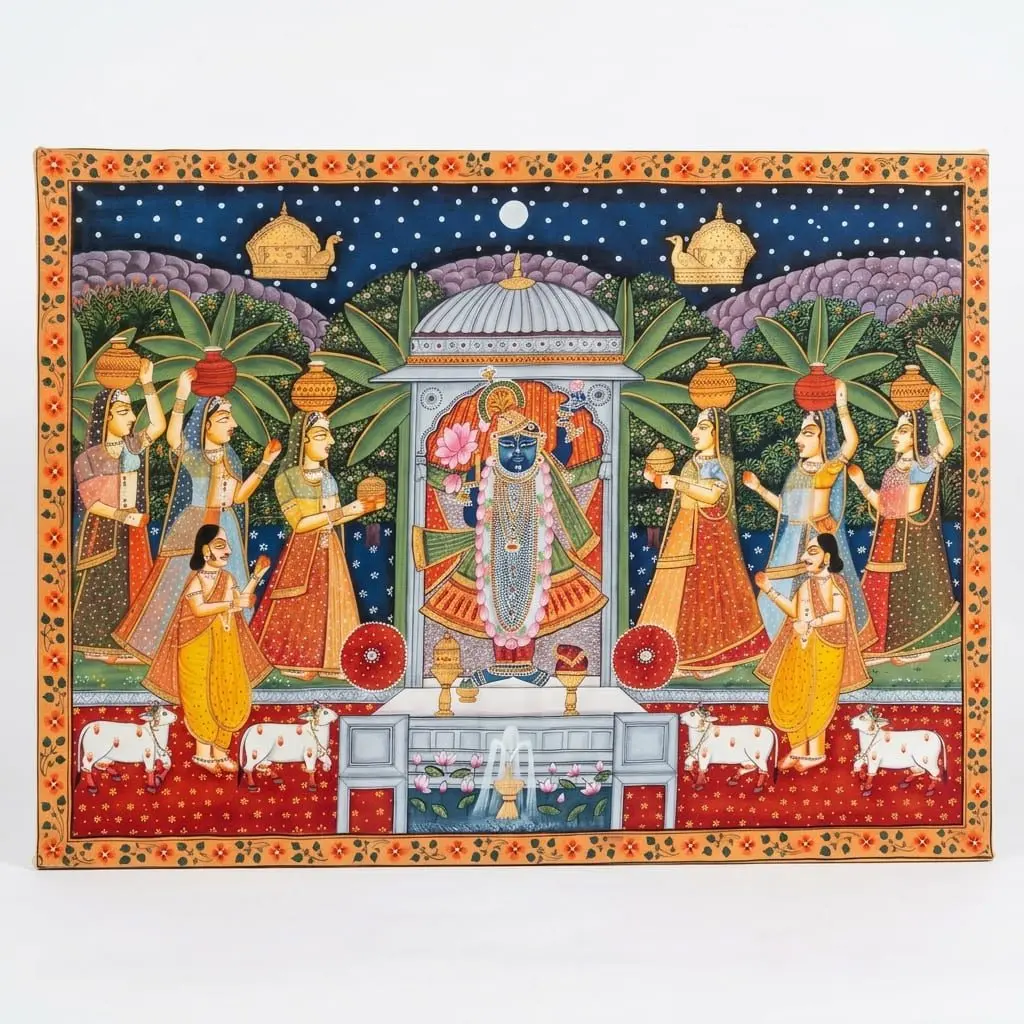
A Sharad Purnima Pichwai painting is the one made for this autumn full moon night. It usually shows a bright full moon over a night scene, with Krishna and the gopis in a joyful dance, surrounded by trees, flowers and the landscape of Vrindavan.
Since When Has Pichwai Painting Shown Sharad Purnima?
Because Sharad Purnima and Krishna's Raas Leela are so closely connected, Pichwai artists began painting this night as one of their key seasonal themes, showing the full moon, Krishna, and the gopis in a joyful dance. This tradition has continued for generations and is still handpainted by artist families in Nathdwara today.
Symbols in a Sharad Purnima Pichwai
| Symbol | Meaning |
|---|---|
| Full moon | Completeness, calm and the healing light of the night |
| Krishna with the flute | Divine love and the call that draws devotees |
| Dancing gopis | Devotion, joy and surrender |
| Night sky | A quiet, dreamlike mood for the festival night |
| Trees and flowers | The beauty of Vrindavan in the autumn season |
| Gold detailing | Divine light and care in handmade work |
Sharad Purnima Pichwai and Raas Leela Pichwai
Both themes show Krishna dancing with the gopis, so they are often compared. The Sharad Purnima Pichwai highlights the full moon and the festival night. A Raas Leela Pichwai focuses on the dance itself and is a joyful theme that can be enjoyed all year. If you like the dancing scene, you can also see our Raas Leela Pichwai paintings.
What Happens When You Keep a Sharad Purnima Pichwai Painting at Home?
Many people believe that keeping a Sharad Purnima Pichwai painting at home brings a peaceful and positive feeling, since it reminds you of the moon's light, Krishna's blessings, and the goddess Lakshmi's visit on this night. Beyond belief, it is also simply a beautiful piece of art: handpainted, full of detail, and a good way to bring a piece of Indian tradition into your living room, pooja room, or hallway.
Where to hang it
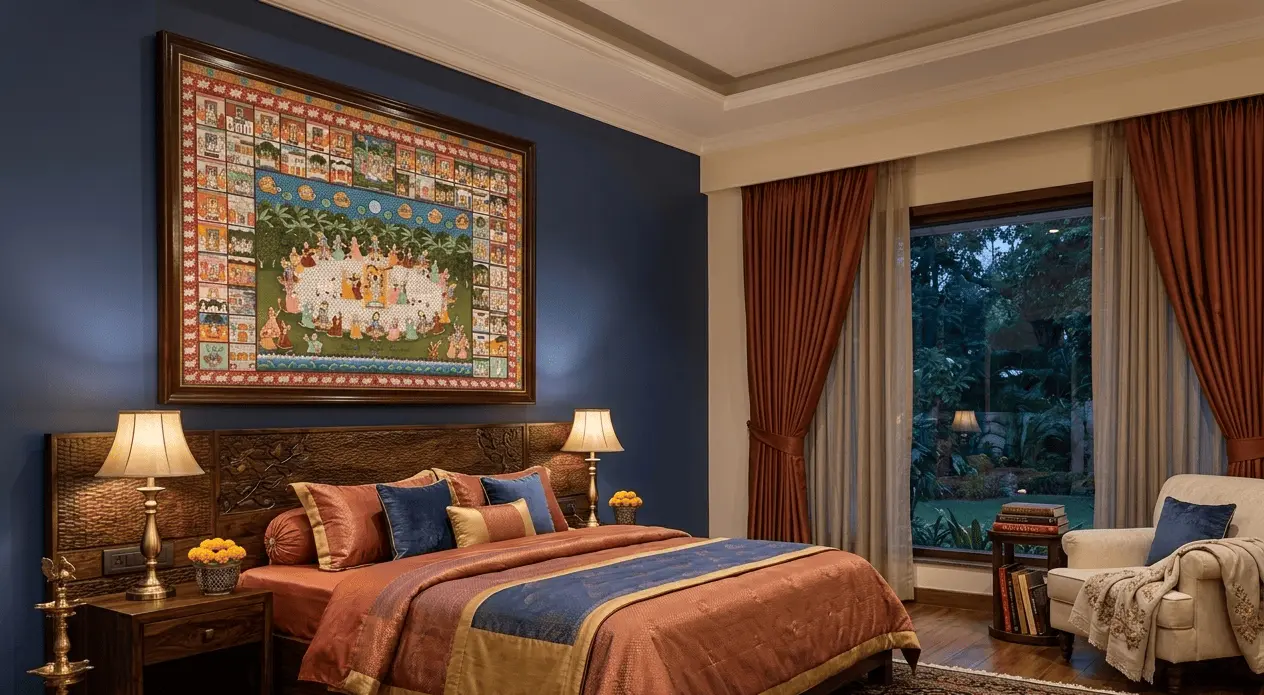
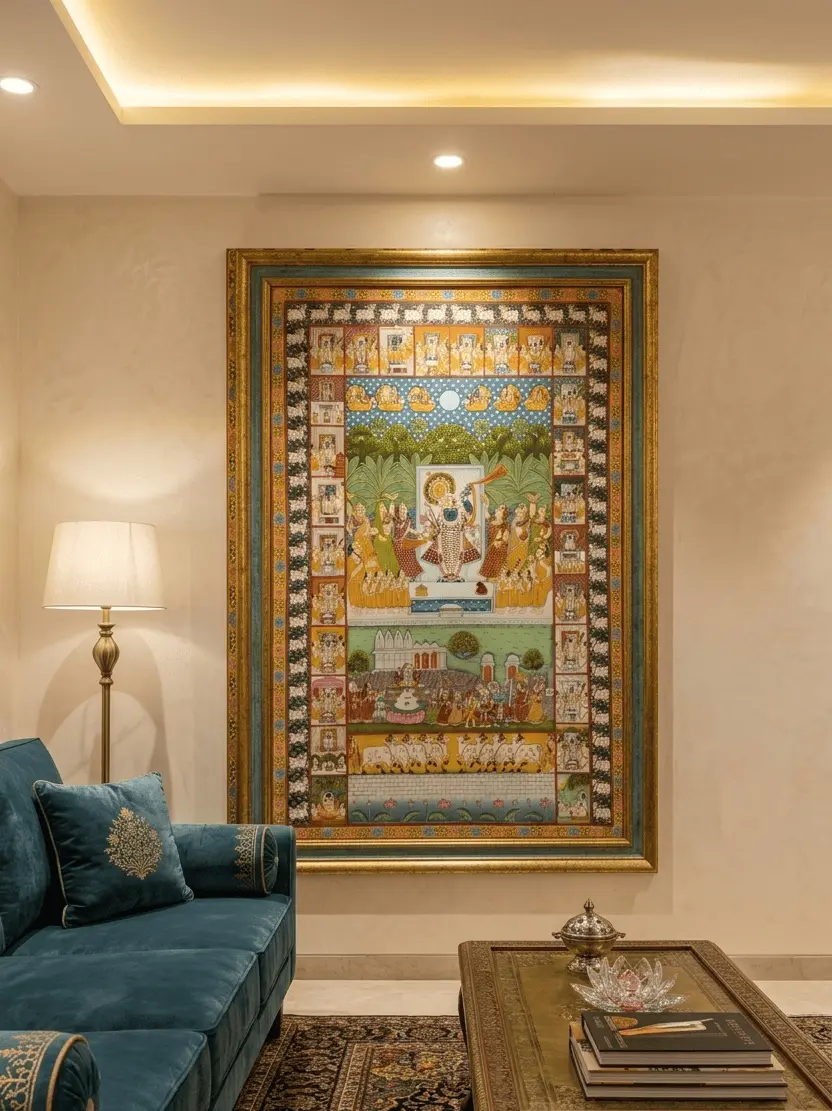
- Living room: on the main wall, where the moonlit scene becomes the centre of the room.
- Pooja room: on a clean wall near the mandir, for a calm devotional mood.
- Hallway or entrance: a warm and welcoming first view for guests.
- Bedroom or study: a quiet night scene suits a peaceful corner.
Hang the painting at or slightly above eye level, and leave some empty wall space around it so that the fine detailing can be seen. Soft, indirect light shows the gold work best.
How to Choose a Handmade Sharad Purnima Pichwai
| Check | What to look for |
|---|---|
| Handmade or print | Fine brush lines, small natural variations, real gold foil shine |
| Base material | Cloth for a traditional look, canvas for easy hanging |
| Size | Measure your wall first. A painting should cover about two-thirds of the furniture width below it |
| Proof | Certificate of Authenticity with the artwork name |
| Packing | Safe packing for pigments and gold foil |
At Rupasya, every Pichwai is 100% handmade by artisans from Nathdwara and Udaipur using natural pigments and gold foil. We do not sell prints. If you want a special size or design, we also make custom Pichwai paintings, and we ship worldwide.
How to Care for Your Pichwai
- Avoid direct sunlight: strong sun can fade natural pigments over time.
- Keep it dry: do not hang it on a damp wall.
- Dust gently: use a soft, dry cloth and do not rub the gold details.
- Avoid water and cleaners: never use water, sprays or chemicals on the surface.
Bring the Festival Night Home
A Sharad Purnima Pichwai captures the calm of a full moon night and the joy of Krishna's dance in one handmade painting. If you want to see this theme in art, browse our Sharad Purnima Pichwai paintings collection. You can also look at our full range of Pichwai paintings for more themes and styles.
Frequently Asked Questions
What does a Sharad Purnima Pichwai painting show?
It usually shows a bright full moon over a night scene, with Krishna and the gopis in a joyful circle of dance, surrounded by trees, flowers and the landscape of Vrindavan. The moon is the main symbol of the festival. The painting recalls Krishna's Raas Leela, which tradition places on this night.
Why is kheer kept in moonlight on Sharad Purnima?
Tradition holds that the moon is fully complete on this night and its light is soothing and healing. Families keep kheer, a sweet milk dish, under the moonlight and eat it the next day as prasad. This is a belief and custom, not a medical claim, and practices vary by region and family.
Is a Sharad Purnima Pichwai the same as a Raas Leela Pichwai?
They are closely related but not identical. Both show Krishna dancing with the gopis, but a Sharad Purnima Pichwai highlights the full moon and the autumn night, linking the scene to the festival. A Raas Leela Pichwai focuses on the dance itself and can be hung throughout the year.
Can I keep a Sharad Purnima Pichwai at home all year?
Yes. Although the theme is linked to one festival night, there is no rule that it must be displayed only then. The moonlit scene, Krishna and the dancing gopis suit a living room, pooja room or hallway throughout the year. Many families simply bring it forward during the festival.
Can I order a Sharad Purnima Pichwai in a custom size?
Yes. At Rupasya you can ask for a custom size, colour or composition. We take an advance, share a digital mockup for your approval and start painting only after you approve it. Send us your wall size, and we will guide you on the best fit. We ship worldwide.