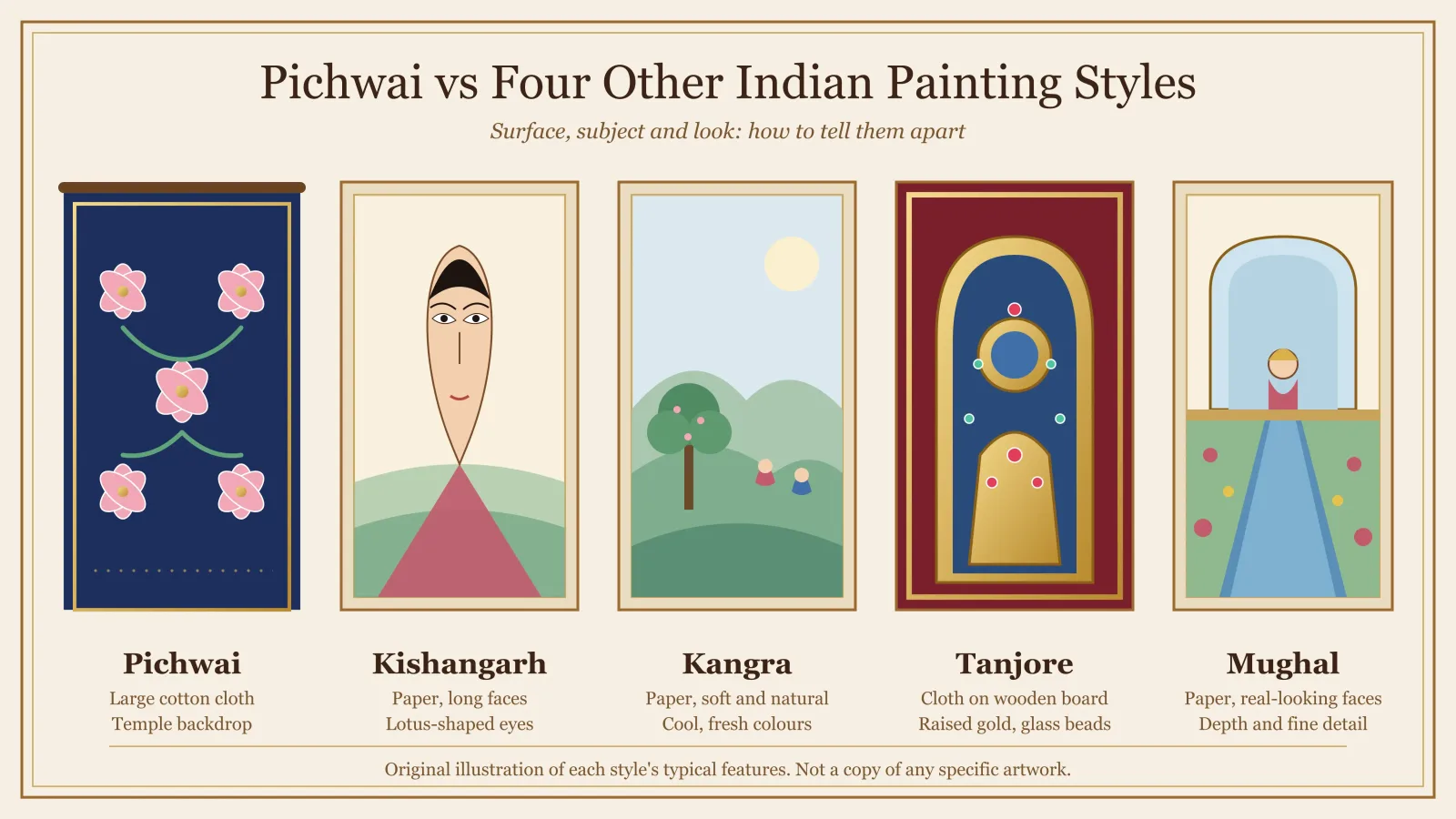
Put a Pichwai next to a Kishangarh miniature, a Tanjore panel and a Mughal court scene, and a first-time buyer can feel lost. All four show gods, kings or lovers. All use rich colour and fine detail. Yet they come from different regions, different centuries and different reasons for being made. This guide separates them in plain terms, so you can name what you are looking at and choose what suits your wall.
We compare five styles: Pichwai, Kishangarh, Kangra, Tanjore (Thanjavur) and Mughal painting. Kishangarh and Kangra are often grouped as miniature schools, Rajput and Pahari. We keep them apart here because buyers meet them as separate looks.
Pichwai vs Kishangarh, Kangra, Tanjore and Mughal: The Quick Comparison
If you only read one section, read this table. Dates and details are simplified, and the sections below explain the hedges.
| Style | Where it grew | Usual surface | Main subject | Look in one line | Made for |
|---|---|---|---|---|---|
| Pichwai | Nathdwara, Rajasthan, in the Pushtimarg tradition | Large cotton cloth | Shrinathji, Krishna, seasonal and festival scenes | Big, dense, decorative, often with gold or silver | Hanging behind the deity in a temple |
| Kishangarh | Kishangarh, Rajasthan, 18th century | Paper | Radha and Krishna, idealised lovers | Very long faces, lotus-shaped eyes, wide lyrical landscapes | Court patrons and personal devotion |
| Kangra | Hill states of the Punjab Himalaya, Pahari school | Paper | Krishna stories, heroines, ragamala, portraits | Soft, naturalistic, cool and fresh colours, delicate line | Hill courts |
| Tanjore | Thanjavur, Tamil Nadu | Cloth pasted on a wooden board | Mostly Hindu deities, often one central figure | Flat bright colour, raised gesso, gold foil, glass beads or stones | Worship and display in homes and shrines |
| Mughal | Mughal court, from the reign of Akbar (1556 to 1605) | Paper | Court life, portraits, history, animals and plants | Realistic faces, depth, fine detail, Persian influence | Emperor's workshop, manuscripts and albums |
Pichwai: A Painting That Works as a Backdrop
A Pichwai is a big painted cloth that sits at the back of the shrine, behind Shrinathji and other forms of Krishna, in the Pushtimarg tradition. The Smithsonian's National Museum of Asian Art describes them as large cotton cloths, swapped according to season and festival. Nathdwara in Rajasthan is the main centre.
Three things set it apart from the others on this list:
- Scale. Pichwais can be very large. Museum records mention examples up to about 8 by 10 feet. The other four styles are usually viewed at hand's reach.
- Purpose. It was made to frame a living deity in worship, not to illustrate a story for a patron to hold and turn over.
- Pattern. Lotuses, cows, gopis, peacocks and flowering trees are repeated across the cloth, so the eye travels over a rich surface instead of resting on a single face.
Materials are opaque watercolour on cotton, with gold or silver leaf in many pieces. A pigment study cited by the Smithsonian lists indigo, red lead, vermilion, iron earths and carbon black, along with tin and gold leaf. If the Pushtimarg background is new to you, our Pushtimarg Explained article covers the faith behind the cloths.
Kishangarh: The Long-Faced Lovers
Kishangarh painting flourished in the 18th century at the court of Raja Savant Singh. The painter most linked to its best-known work is Nihal Chand. Sources differ on the details. The Cleveland Museum of Art, for example, dates a Kishangarh work to Savant Singh's reign and gives 1748 to 1757, while Wikipedia gives his reign as 1748 to 1764. The safe way to say it is mid-18th century.
Savant Singh was a poet who wrote as Nagari Das and followed the Vallabha sect of Krishna devotion. That is why Radha and Krishna dominate the style. The most famous image, usually called Bani Thani, is said to show a court singer and poet. Her identity as the model is described by scholars as assumed rather than proven, and the idea that she stands for Radha is a belief. An Indian stamp carried the image in 1973.
How to recognise it: elongated faces, arched brows, lotus-shaped eyes, a pointed chin and broad, airy landscapes. Compared with Pichwai, the figures are the point, and the scene is read as a poem.
Kangra: Gentle, Cool and Natural
Kangra belongs to the Pahari ("of the hills") family of painting, which Britannica dates from about 1690 to about 1900. It had a fully developed style by around 1770, helped by patrons such as Raja Sansar Chand of Kangra. Sources give slightly different dates for his rule, so we avoid pinning one year.
Kangra painters favoured soft, lyrical scenes. Krishna stories, heroines in waiting, ragamala and portraits were common. Colours are cool and fresh, lines are delicate, and faces are gentle. Late Mughal naturalism shaped it, but the mood is quieter and more tender than court painting in the plains.
Next to a Kishangarh work, a Kangra painting feels softer and more natural. Next to a Pichwai, it is calm and open instead of dense and ornamental.
Tanjore: Raised Gold and Glass
Tanjore, or Thanjavur, painting comes from Tamil Nadu. Its roots are linked to Nayak patronage around 1600, and the form we know today grew in the Maratha court of Thanjavur, which ruled from 1676 to 1855. It received a Geographical Indication tag around 2007 to 2008.
The method is what makes it unmistakable. Cloth is pasted on a wooden board, and a paste of chalk or limestone is built up into raised areas. Gold foil is applied over these, and glass beads or stones may be set into jewellery and crowns. Colours are flat and vivid, and the main deity usually sits in the centre under an arch.
The key difference from a Pichwai is that a Tanjore panel is sculpted and shiny, while a Pichwai is painted flat on a cloth.
Mughal: The Realist Court Style
Mughal painting began under Akbar (1556 to 1605). The Metropolitan Museum and Smarthistory describe how Persian masters, including Mir Sayyid Ali and Abd us Samad, joined the court, and how the imperial workshop grew to over a hundred artists. The Hamzanama project alone involved about 1,400 large paintings.
Mughal work is usually opaque watercolour, ink and gold on paper. Under Jahangir, painters leaned further into portraits, animals and plants, and under later rulers into court ceremony. Faces are individual, space has depth, and detail is exact. Scholars note that Mughal painters portrayed real individuals, while Rajput painters often showed idealised types. After the early 18th century, artists moved to Rajput and other courts, which is one reason the styles overlap.
How to Tell Them Apart at a Glance
Ask these questions in order.
- Is it raised, shiny and mounted on a board? It is Tanjore style.
- Is it very large, on cloth, with a pattern of repeated motifs? It is Pichwai.
- Is it on paper with real-looking faces, depth and a court scene? It is Mughal.
- Is it on paper with long, stylised faces and lotus eyes? It is Kishangarh.
- Is it on paper with soft colours, gentle faces and a natural landscape? It is Kangra.
Real pieces break the rules. Artists borrowed from one another, so use this as a first filter, not a certificate.
Myths and Mix-Ups
- Myth: Shrinathji gold-foil paintings are Pichwai. Many sellers sell Shrinathji in the raised, gold-foil Tanjore manner. That is a hybrid of subject and technique. A traditional Pichwai is a painted cloth.
- Myth: Miniature means small. It describes the painting tradition of small, detailed works on paper, as in Mughal, Kishangarh and Kangra. A Pichwai is not a miniature.
- Myth: Kishangarh and Kangra are the same. Both are often called Rajput or hill miniatures, but they come from different regions and look different.
Which Style Suits Which Room?
This is a practical guide, not a rule.
| Space | Style that tends to work | Why |
|---|---|---|
| Large living room wall or lobby | Pichwai | Its scale and pattern fill a wall without feeling empty |
| Prayer room or home temple | Tanjore-style or Pichwai | Both are made for devotion, and gold catches lamplight |
| Study, bedroom or passage | Kangra or Kishangarh | Intimate size, quiet mood, easy to group in a set |
| Dining room or library | Mughal-style | Detailed, story-led, rewards close viewing |
Light matters too. Raised gold looks different at night than in daylight, and paper miniatures prefer indirect light.
What to Ask Before You Buy
- Which tradition is this, and is the seller describing the style honestly?
- What is it painted on: paper, cloth or board?
- Is the gold real foil or a printed or painted effect?
- Who painted it, and will the seller say so in writing?
For handmade versus printed work, read how to identify authentic Pichwai paintings. For where Shrinathji art sits among these styles, see our Nathdwara painting history page.
A Note from Rupasya
We make and sell handmade paintings in several of these traditions, so we have a view, and you should weigh it that way. You can browse our Pichwai paintings, Mughal miniature paintings and Nathdwara paintings, or look at our miniature art paintings if you prefer a smaller scale.
Frequently Asked Questions
How is Pichwai different from Tanjore painting?
A Pichwai is a large cloth painted flat, made to hang behind Shrinathji in the Pushtimarg tradition, centred on Nathdwara. A Tanjore painting comes from Thanjavur in Tamil Nadu and is built on a wooden board with raised gesso, gold foil and sometimes glass beads or stones.
Is Pichwai a miniature painting?
Not usually. Miniature painting means small, detailed works on paper, as in Mughal, Kishangarh and Kangra styles. A Pichwai is a large painted cloth, sometimes several feet across, made as a backdrop for a deity in worship, so it is read as a wall-sized scene, not a handheld page.
What is the difference between Kishangarh and Kangra painting?
Kishangarh, from Rajasthan, is known for very long faces, lotus-shaped eyes and airy landscapes around Radha and Krishna. Kangra, from the Himalayan foothills, is softer and more naturalistic, with cool colours, delicate lines and gentle faces. Both are paper paintings, but the face shapes are the quickest clue to tell them apart.
Which Indian painting style suits a large living room wall?
A Pichwai usually works best on a large wall because of its scale and repeated pattern. Paper miniatures such as Kangra or Kishangarh suit smaller, quieter spaces like studies or passages, especially when framed in a group. Match the size of the work to the wall, and check the lighting first.


