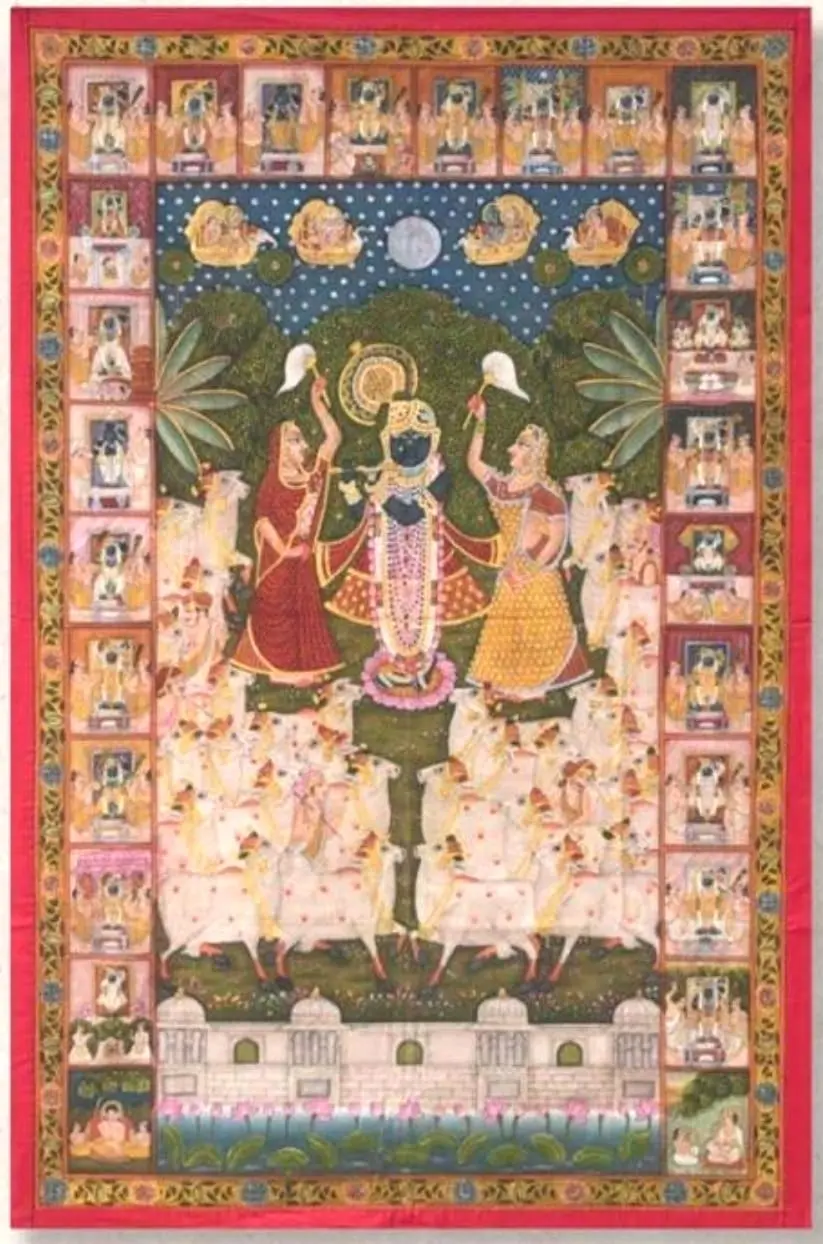
Few images carry as much warmth and meaning in Indian homes as a cow painting. Whether it's a grazing cow rendered in earthy Madhubani lines, a folk-art Warli herd, or a gold-foil, jewel-adorned Kamdhenu on a Nathdwara Pichwai, the cow has been a recurring, sacred subject across almost every regional Indian art form for centuries.
If you're looking to buy a cow painting for your home, office or as a gift, this cow painting guide walks you through the major styles, what each one symbolises, and how to tell an authentic handmade piece from a mass-printed one, so you know exactly what to look for before you buy.
Why the Cow Appears So Often in Indian Art
Across Indian traditions, the cow (Gau Mata) is seen as a symbol of nourishment, selfless giving and abundance. In Vaishnav and Krishna-centric traditions especially, the cow is inseparable from Krishna's own story as Gopala, the cowherd of Vrindavan. This is exactly why cow motifs are so central to Pichwai paintings from Nathdwara, Rajasthan.
The same bond is celebrated every year on Gopashtami, the day Krishna became a full cowherd. If you want to see that festival in art, browse our Gopashtami Pichwai paintings.
Styles of Cow Painting in Indian Art
Not every cow painting is a Pichwai, and knowing the difference helps you pick the right piece for your space.
Pichwai cow painting (Nathdwara, Rajasthan)
The most detailed and devotional style. Cows, especially Kamdhenu, the divine wish-fulfilling cow, are painted with intricate jewellery, peacock-feather ornaments, lotus ponds and gold foil, using natural stone pigments on cloth or canvas. This is temple-backdrop art at its origin, and the style most associated with prosperity and Vastu.
Madhubani cow painting (Bihar)
Bold outlines, flat colours and geometric patterns fill the canvas. Cows here are usually part of a larger pastoral or festive scene, painted in a folk tradition passed down through generations.
Warli cow painting (Maharashtra)
Minimal, tribal and monochrome. Cows are reduced to simple triangular and circular forms on a mud-brown or white background. A Warli cow painting suits a rustic, minimalist interior far better than a puja room.
Tanjore cow painting (Tamil Nadu)
Rich relief work, gold foil and gemstone inlay, usually featuring Krishna with cows. It is closer in spirit to Pichwai but distinct in technique, with a raised, 3D gesso finish.
Contemporary and Western cow painting
Realistic or abstract cow portraits in oil or acrylic, popular in farmhouse and rustic-modern décor, with no religious symbolism attached.
Cow painting styles at a glance
| Style | Look and feel | Best suited for |
|---|---|---|
| Pichwai | Detailed, devotional, gold foil and natural pigments | Puja rooms, living rooms, gifting |
| Madhubani | Bold outlines, flat colours, folk patterns | Colourful, casual interiors |
| Warli | Minimal, tribal, monochrome | Rustic and minimalist spaces |
| Tanjore | Raised relief, gold and gemstone work | Traditional, rich interiors |
| Contemporary | Realistic or abstract, no religious theme | Farmhouse and modern décor |
Among all of these, Pichwai cow paintings remain the most sought-after for Indian homes and pooja spaces. They combine devotional meaning, fine craftsmanship and Vastu significance in a way the other styles do not.
What Makes a Cow Pichwai Painting Different
A cow Pichwai painting isn't a casual sketch of a cow. It is built around specific, recurring motifs:
- Kamdhenu, the divine cow, shown adorned with peacock feathers and ornaments
- Lotus ponds (Kamal Talai), representing the sacred banks of the Yamuna
- Cow and calf compositions, symbolising nurture and family bonds
- Gau Seva scenes, where Shrinathji is shown among his cows
We have covered the deeper mythology, symbolism and Vastu placement of these motifs in our Kamdhenu Cow Pichwai art guide, which is worth a read if you want the full spiritual context before you buy. To understand the art form itself, you can also read about Shrinathji Pichwai paintings.
How to Identify an Authentic Handmade Cow Painting
This is where most buyers get it wrong online. Here are a few checks before you pay:
- Look for natural pigment texture, not print gloss. Authentic Pichwai cow paintings use stone-ground pigments. The surface has a slight matte, textured feel, not a flat printed sheen.
- Ask if the gold work is real foil or printed gold ink. Real gold foil catches light unevenly and has a raised, tactile edge, while printed "gold" looks uniformly flat.
- Check for an artist attribution or Certificate of Authenticity. Genuine sellers can name the artisan family or workshop the piece came from.
- Compare price to production time. A hand-painted cow Pichwai takes days to weeks to complete. Anything priced like a poster print, in the ₹500 to ₹1,000 range for a large detailed piece, is almost certainly a machine print.
- Zoom into the details. In a real hand-painted piece, brushstrokes, jewellery outlines and lotus petals show tiny natural variations. A print looks mechanically identical if you compare two "same design" listings.
Size Guide for Cow Paintings
| Size | Best for |
|---|---|
| Small (12x12 in to 18x24 in) | Single cow or Kamdhenu portraits, good for personal altars or office desks |
| Medium (24x36 in to 36x48 in) | Living-room feature pieces, Kamdhenu with lotus or cow-and-calf scenes |
| Large (48x60 in and above) | Statement Gau Seva pieces with multiple cows, suited to bigger walls or institutional spaces |
Measure your wall before you decide, and leave some empty space around the painting so that the detailing can be seen.
Where to Hang a Cow Painting
Traditionally, the north and north-east walls are considered most auspicious, and many Vastu guides suggest avoiding bathrooms and the wall directly above the bed. Vastu is a belief tradition, so treat this as a guide and choose the wall that also looks best in your room. We have shared a room-by-room placement guide in our Kamdhenu Pichwai Vastu guide.
- Living room: a medium or large cow Pichwai as the main wall art.
- Pooja room: a Kamdhenu or Gau Seva painting on a clean wall near the mandir.
- Office: a Kamdhenu painting on the north wall for a positive, welcoming feel.
- Entrance: a cow-and-calf scene for a warm first view.
Best Occasions to Gift a Cow Painting
A handmade cow Pichwai painting is a popular gift for housewarmings, weddings and the birth of a child, largely because of the Kamdhenu-with-calf motif's association with nurture and abundance. It is also commonly gifted to business associates for office inaugurations, tied to its Vastu association with the north wall and financial growth.
How to Care for Your Cow Painting
- Avoid direct sunlight: strong sun can fade natural pigments over time.
- Keep it dry: do not hang it on a damp wall.
- Dust gently: use a soft, dry cloth and do not rub the gold foil.
- Avoid water and cleaners: never use water, sprays or chemicals on the surface.
Shop Authentic Cow Pichwai Paintings
Every cow Pichwai painting at Rupasya is 100% handmade by Nathdwara and Udaipur artisans, using natural stone pigments and genuine gold foil. There are no prints and no shortcuts. If you want a special size, colour or composition, we also make custom Pichwai paintings, and we ship worldwide.
Explore the full Cow Pichwai Painting collection →
You can also see our wider Pichwai paintings collection, or explore the Tree of Life Pichwai paintings, where cows rest beneath the wish-fulfilling tree.
Frequently Asked Questions
Q1: Is every cow painting a Pichwai painting?
A1: No. Cow motifs appear in Madhubani, Warli, Tanjore and contemporary art too. Pichwai is a specific Nathdwara tradition known for intricate detailing, natural stone pigments and gold foil work, usually centred on Kamdhenu or Krishna's cows. A Warli or Madhubani cow looks very different in style and mood.
Q2: What size cow painting works best for a living room?
A2: Most buyers choose a 24x36 inch or 36x48 inch painting for a feature wall. This size is large enough to be a focal point without overwhelming the room. Measure your wall first, and aim for a painting that covers about two-thirds of the width of the furniture below it.
Q3: Where should I hang a cow painting at home?
A3: Many Vastu guides suggest the north or north-east wall, and advise avoiding bathrooms and the wall directly above the bed. Vastu is a belief tradition, so treat it as guidance. A living room, pooja room or entrance wall with soft light and some empty space around the painting works well.
Q4: What does Kamdhenu mean in a cow painting?
A4: Kamdhenu is the divine wish-fulfilling cow of Hindu tradition, seen as a giver of nourishment and abundance. In Pichwai art she is often painted with jewellery, peacock-feather ornaments and a lotus pond. Many families choose a Kamdhenu painting for the home as a symbol of prosperity and care.
Q5: Is a cow Pichwai painting a good gift?
A5: Yes. It is a popular gift for housewarmings, weddings, the birth of a child and office inaugurations, because the cow stands for nurture and abundance. Choose a size that suits the receiver's wall, prefer a handmade piece, and include a Certificate of Authenticity so the recipient knows it is original.