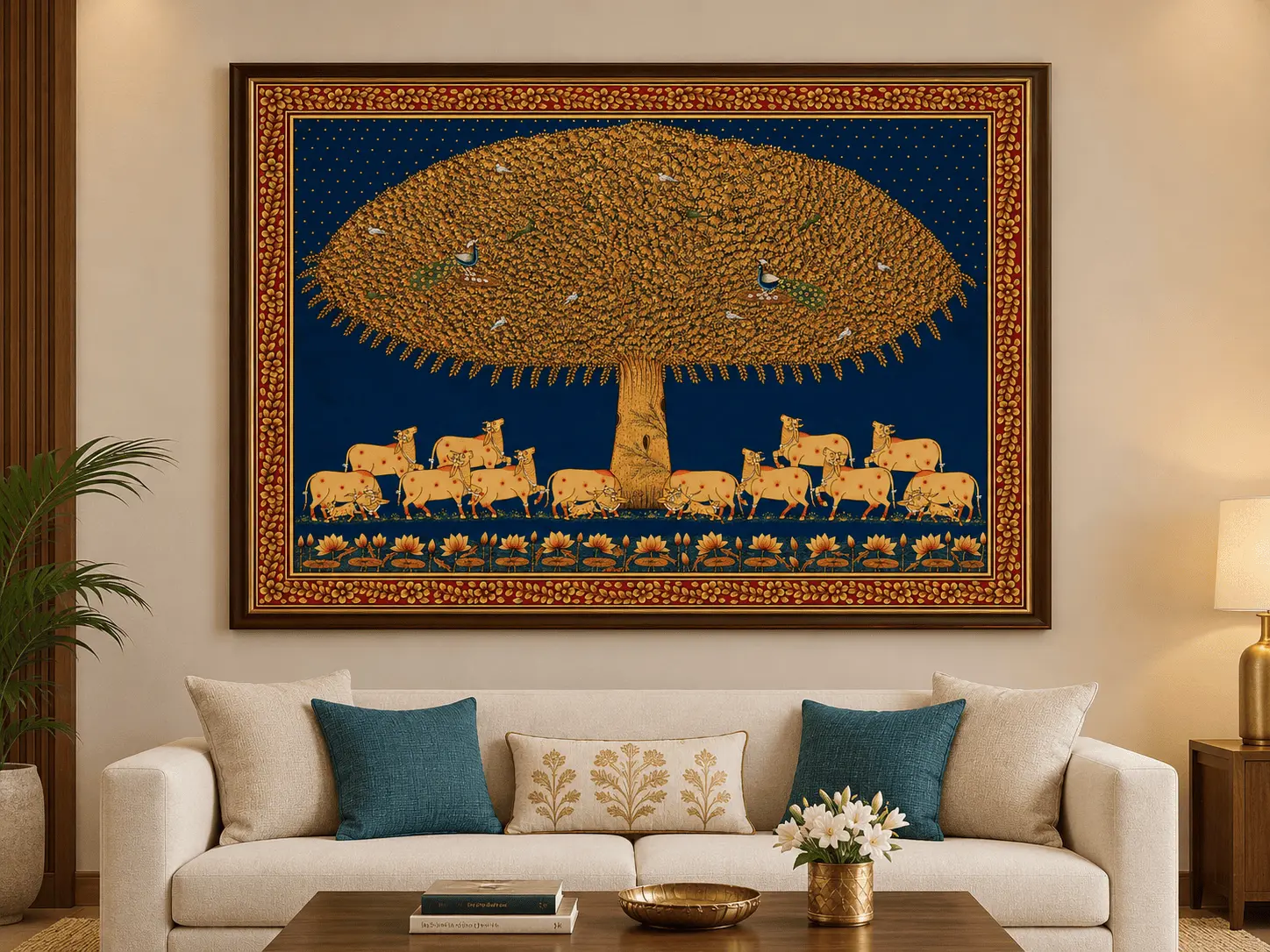
A tall tree with a thick golden crown, cows resting beneath it, peacocks in the branches and a lotus pond at its feet. If you have seen a Pichwai painting like this, you have seen the Kalpavriksha. A Kalpavriksha tree painting is one of the most loved themes in Pichwai art, and every part of it carries a meaning. This guide explains what the tree means, what each symbol stands for, and how to place the painting in your home.
If you want to see finished pieces while you read, browse our Tree of Life Pichwai paintings.
What is the Kalpavriksha?
Kalpavriksha is a Sanskrit name for the wish-fulfilling tree. In Indian tradition it is a divine tree that gives what one needs. It is often named together with Kamdhenu, the sacred cow that also grants wishes, and both are linked in tradition with the churning of the ocean of milk.
Artists across India have painted this tree in many styles. It is often called the Tree of Life, because it stands for growth, shelter and a life that is looked after. In Pichwai art it takes a special form: a large, full canopy painted leaf by leaf, often in gold.
What is Pichwai painting?
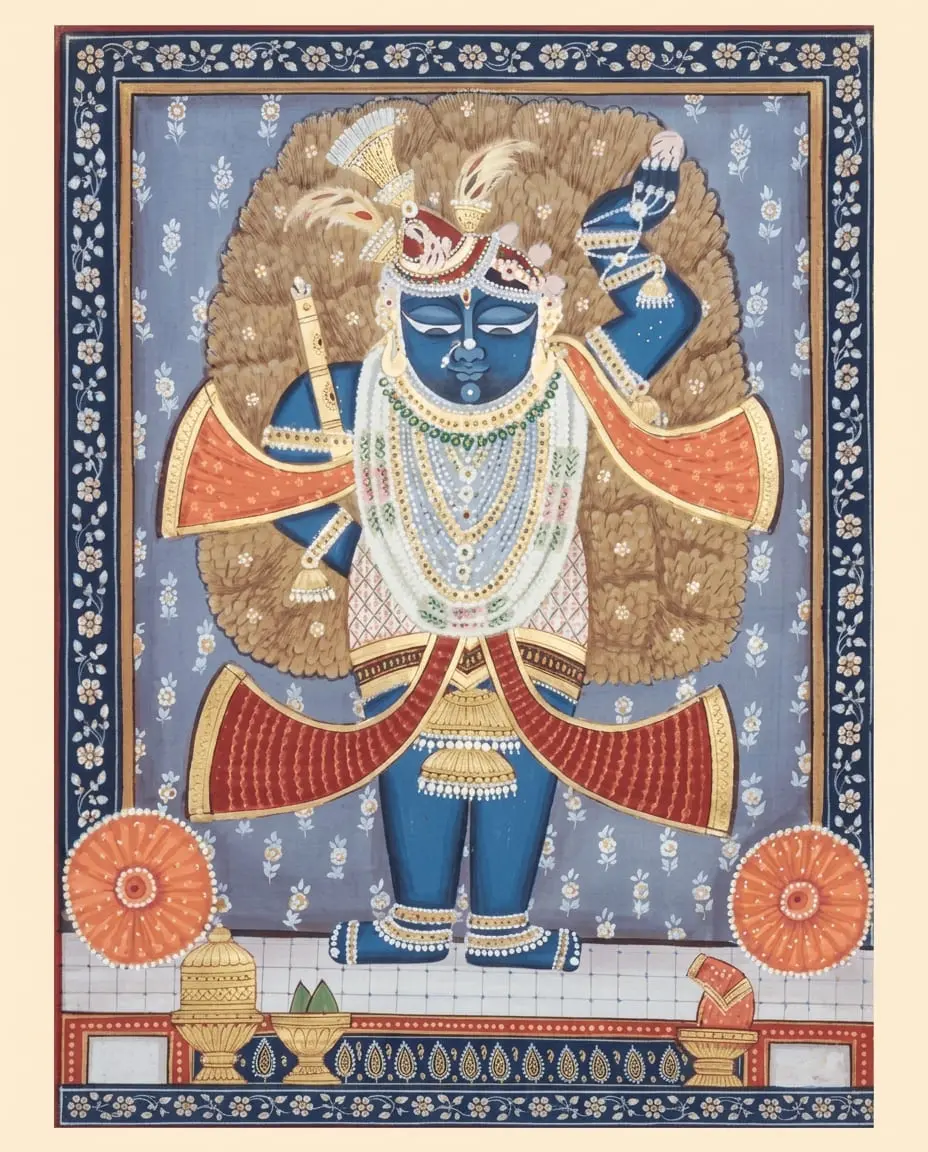
The word Pichwai comes from pichh (back) and wai (hanging). These are large cloth paintings that were made to hang behind the idol of Shrinathji, a form of Krishna, in the Shrinathji temple at Nathdwara in Rajasthan. Today the same style is painted for homes, and Nathdwara is still the name most linked with it. You can see more of this art in our collection of handmade Pichwai paintings from Nathdwara.
What is a Kalpavriksha tree painting in Pichwai art?
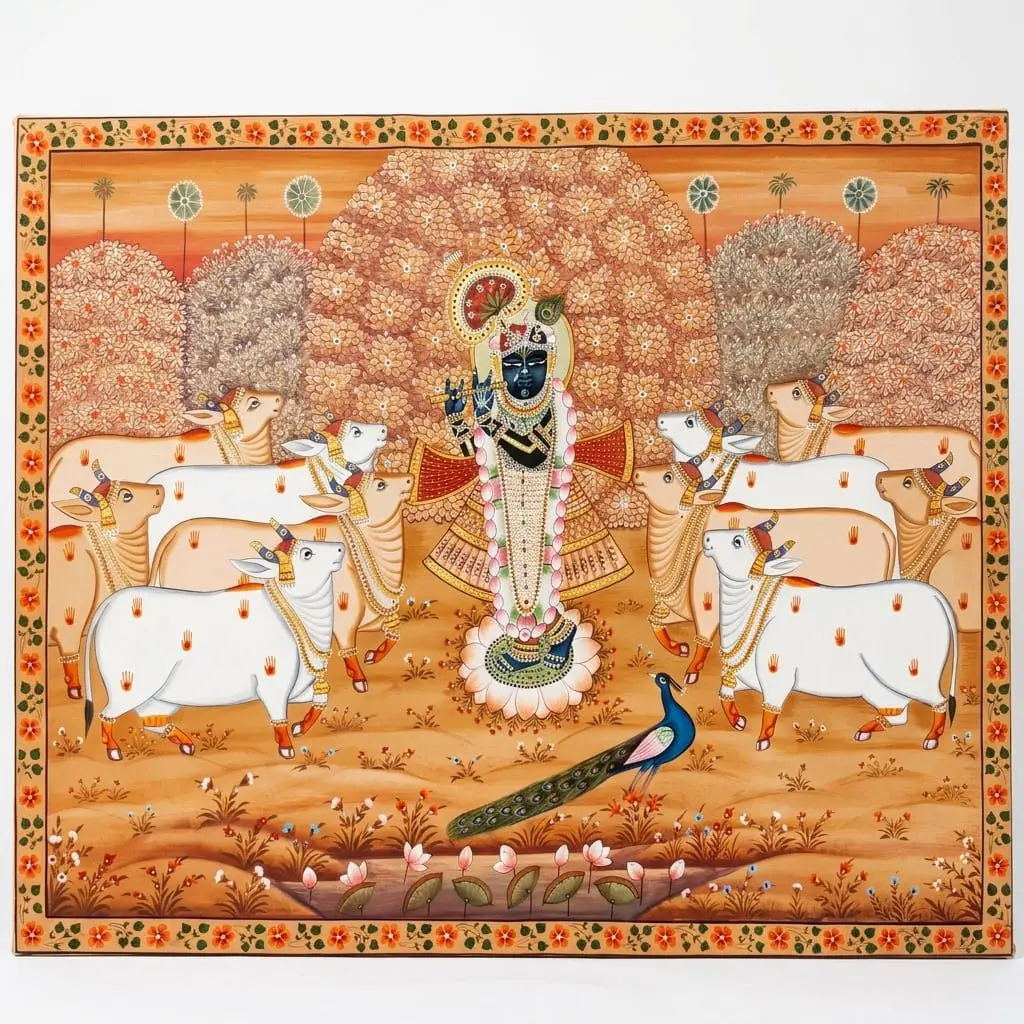
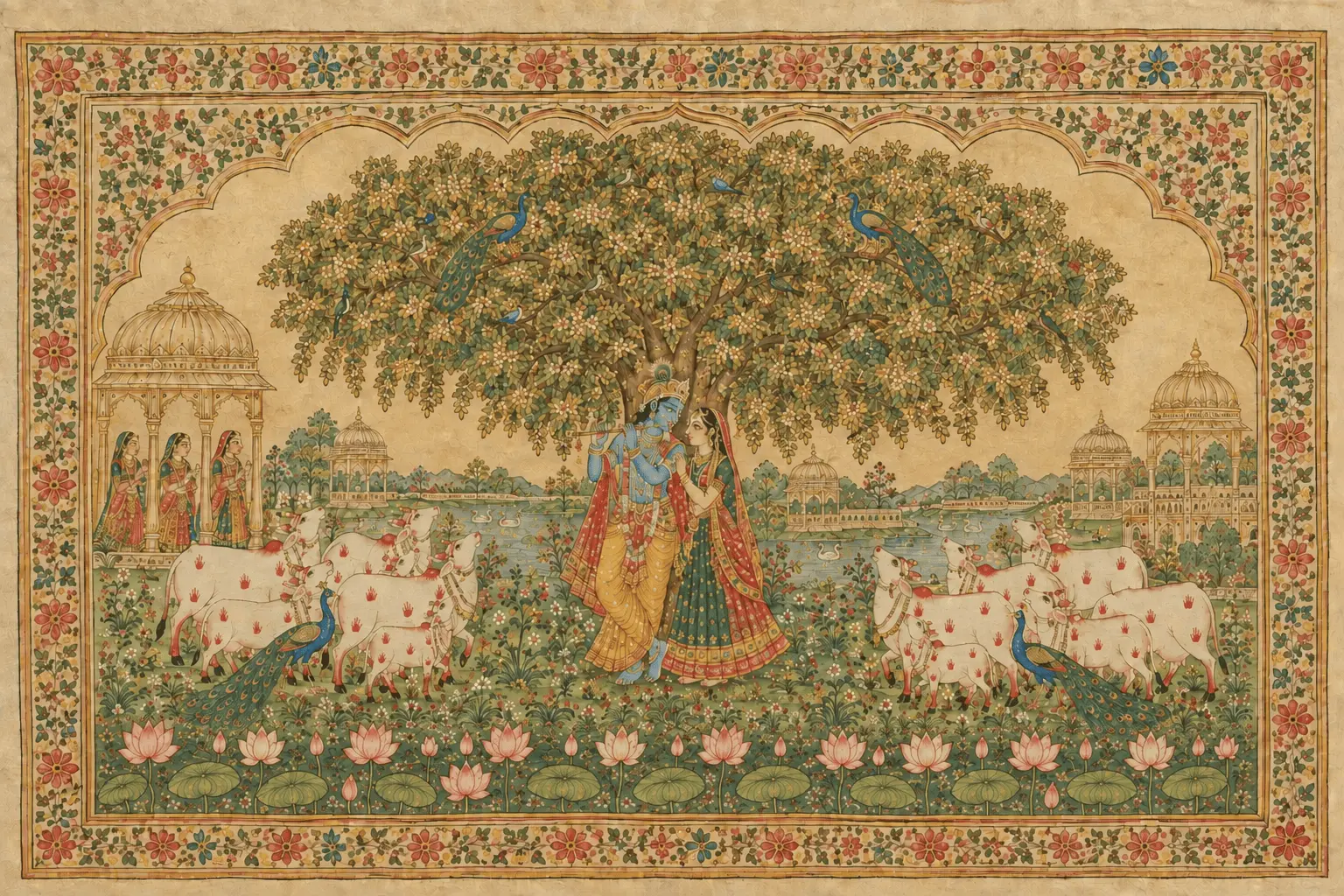
A Kalpavriksha tree painting in Pichwai style shows one large tree as the centre of the whole scene. The trunk rises from the lower part of the painting and the canopy spreads wide, filling most of the canvas with fine leaves. Around the tree, the artist paints the world of Vrindavan: cows, peacocks, small birds and a lotus pond.
Because of the dense leafwork, this is one of the most detailed Pichwai themes. Each leaf is painted by hand, which is why no two paintings look exactly alike.
What the symbols usually mean
- The golden canopy: Abundance and shelter. The dense leaves show a tree that never runs out.
- Cows (Kamdhenu): In Krishna's world of Vrindavan, cows stand for nourishment, care and gentleness. Kamdhenu is the sacred cow that also grants wishes.
- Peacocks: Beauty and joy. The peacock is closely linked with Krishna.
- Lotus pond: Purity and calm. The lotus grows in water and stays clean.
- Small birds: Life, movement and the bond between earth and sky.
- Sun or stars: A golden sunrise gives a warm, hopeful mood. A starry night gives a quiet, meditative mood.
Why these symbols suit a home
Taken together, the symbols make a very positive picture: shelter above, nourishment below, beauty in the branches and calm in the water. This is why many families choose a Kalpavriksha painting for spaces where they want a peaceful and welcoming feeling.
Three moods of the same tree
The same Kalpavriksha can feel very different depending on the colours the artist chooses. Here are three popular moods.
- Golden sunrise: Warm and cheerful, with a red sun and a single row of cows.
- Midnight sky: Deep green-black with stars, six cows facing the trunk. Calm and bold.
- Royal blue with a floral border: Rich and formal, like a framed heritage piece.
Which mood should you choose?
| Mood | Feels like | Works well in |
|---|---|---|
| Golden sunrise | Warm, hopeful, welcoming | Cool-toned rooms, entrance halls, family spaces |
| Midnight sky | Calm, deep, meditative | Living rooms with light walls, pooja rooms, quiet corners |
| Royal blue with floral border | Rich, formal, traditional | Heritage-style homes, offices, formal sitting rooms |
Where to hang a Tree of Life painting
Many Vastu guides suggest the east or north-east wall, kept clean and well lit, and hung at or above eye level. Popular spots are the living room, pooja room, entrance hall or office. Vastu is a belief tradition, so treat this as a guide and choose the wall that also looks best in your room.
A simple design tip: pick a wall with some empty space around the painting. A dark background looks striking on a light wall. A golden background brings warmth to a cool-toned room.
Room-wise ideas
- Living room: above the sofa or on the main wall, as the central piece of the room.
- Pooja room: on a clean wall near the mandir, where the calm mood of the painting fits well.
- Entrance hall: a welcoming first view for guests, especially in a golden tone.
- Office or study: a quiet, focused backdrop, often in the midnight or royal blue mood.
Choosing the right size
As a general rule, pick a painting that covers about two-thirds of the width of the furniture below it. Measure your wall before you decide, and leave some empty space around the painting so that the detailed canopy can be seen properly. If you are not sure about the size, send us your wall measurements and we will help you choose.
How to tell a handmade Pichwai from a print
- Look closely at the leaves and gold details. Hand-painted work shows small natural differences.
- Ask the seller for close-up photos and details of the making.
- Ask whether the size and colours can be adjusted for your wall.
A print looks flat and uniform, and under close view you may see tiny dots. A handmade painting has fine, slightly varied brushwork and gold that catches light differently as you move.
At Rupasya every painting is 100% handmade. For custom orders we take an advance, share a digital mockup for your approval, and start painting only after you approve. We ship worldwide.
Want a size or colour of your own?
If none of the ready paintings fits your wall or your colours, you can ask for a custom Pichwai painting. Send us your wall size and the mood you like, and we will share a digital mockup before painting begins.
How to care for your Pichwai
- Avoid direct sunlight: strong sun can fade natural colours over time.
- Keep it dry: do not hang it on a damp wall.
- Dust gently: use a soft, dry cloth and do not rub the gold details.
- Avoid water and cleaners: never use water, sprays or chemicals on the surface.
Ready to choose?
See the full range of Kalpavriksha tree paintings or explore all Pichwai paintings from Rupasya. If you love paintings of cows and Krishna's Vrindavan, you may also like our Gopashtami Pichwai paintings.
Frequently Asked Questions
What does the Kalpavriksha tree mean in Pichwai painting?
The Kalpavriksha is the wish-fulfilling tree of Indian tradition. In Pichwai painting, its full golden canopy stands for abundance and shelter, while the cows, peacocks and lotus pond around it add nourishment, joy and purity. Together the scene is read as a symbol of blessings and a home that lacks nothing.
Why are cows painted under the Kalpavriksha?
Cows are closely linked with Krishna's Vrindavan, where they stand for nourishment, care and gentleness. The sacred cow Kamdhenu is also said to grant wishes, so cows beneath the wish-fulfilling tree strengthen the message of abundance. Many Pichwai artists paint them resting calmly, which gives the whole scene a peaceful mood.
Which direction is best to hang a Tree of Life painting?
Many Vastu guides suggest the east or north-east wall, kept clean and well lit, with the painting at or above eye level. Vastu is a belief tradition, so treat this as guidance only. If another wall suits your room better, choose that one, because a painting you enjoy looking at matters most.
Can I order a Tree of Life Pichwai painting in my own size or colours?
Yes. Custom sizes and colour changes are possible at Rupasya. Share your wall size and we send a digital mockup for your approval. For custom orders we take an advance and begin painting only after you approve the mockup. We ship worldwide.
Is a Kalpavriksha Pichwai only for the pooja room?
No. It works well in a living room, pooja room, entrance hall or office. Choose a wall with some empty space around the painting. A dark background looks striking on a light wall, while a golden background brings warmth to a cool-toned room.