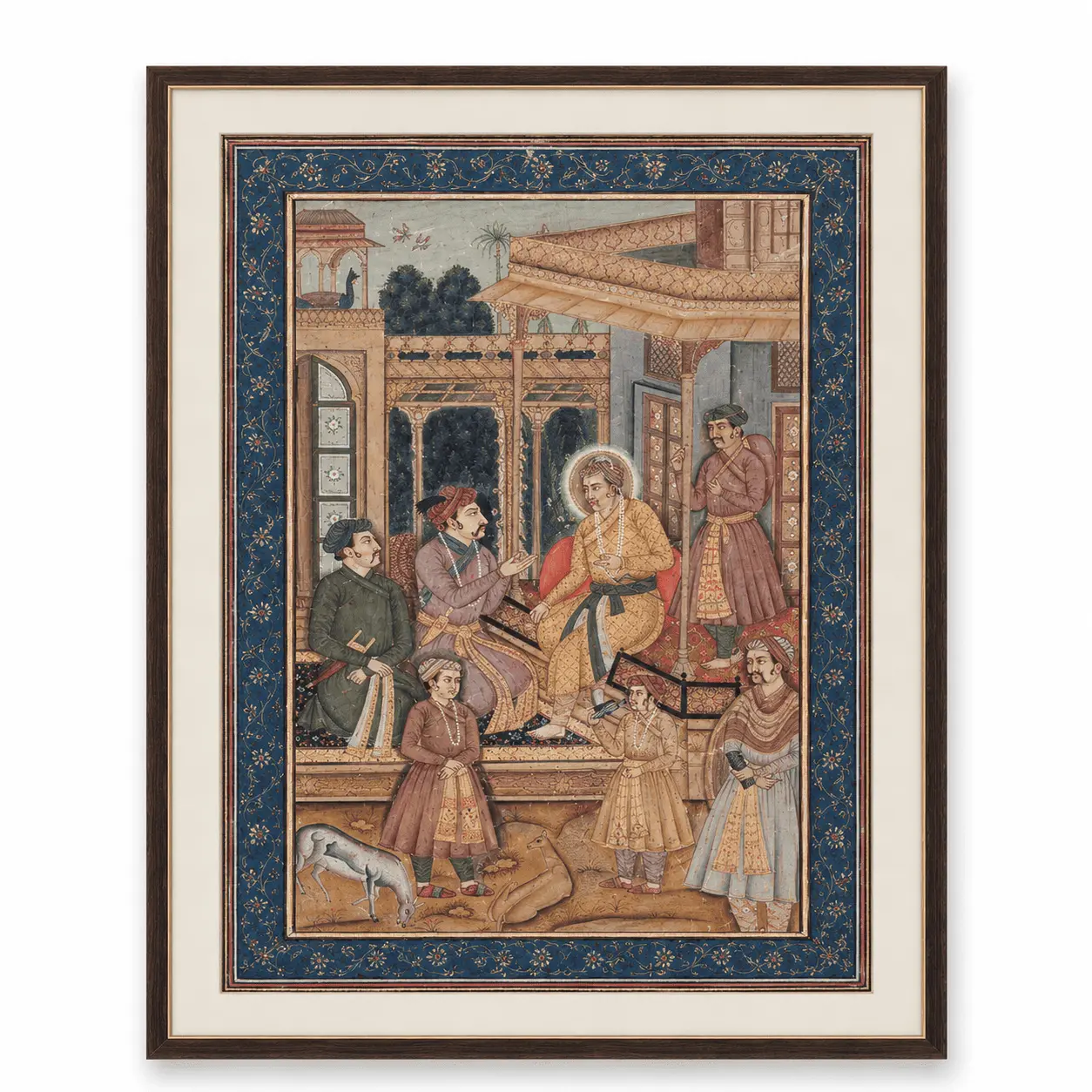
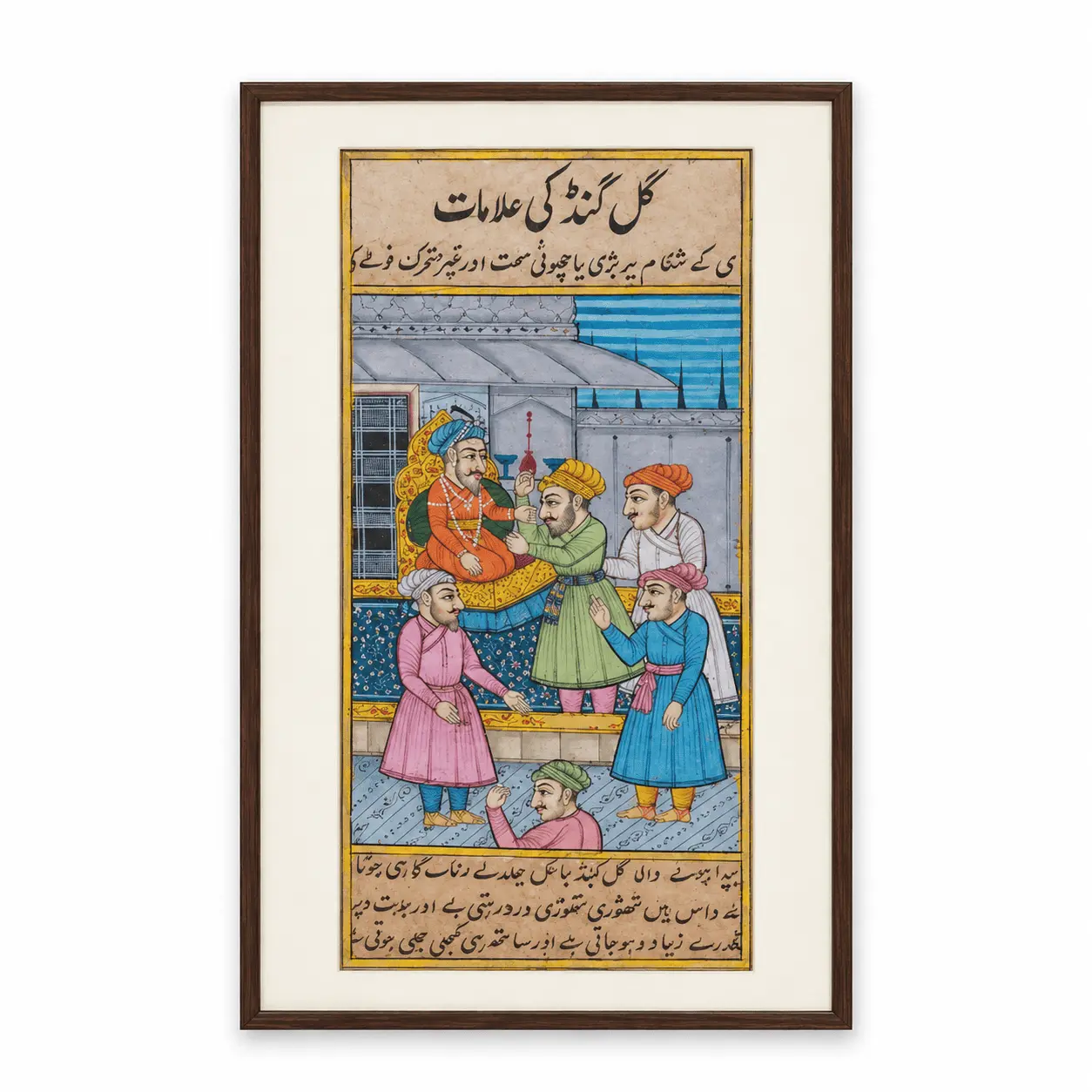
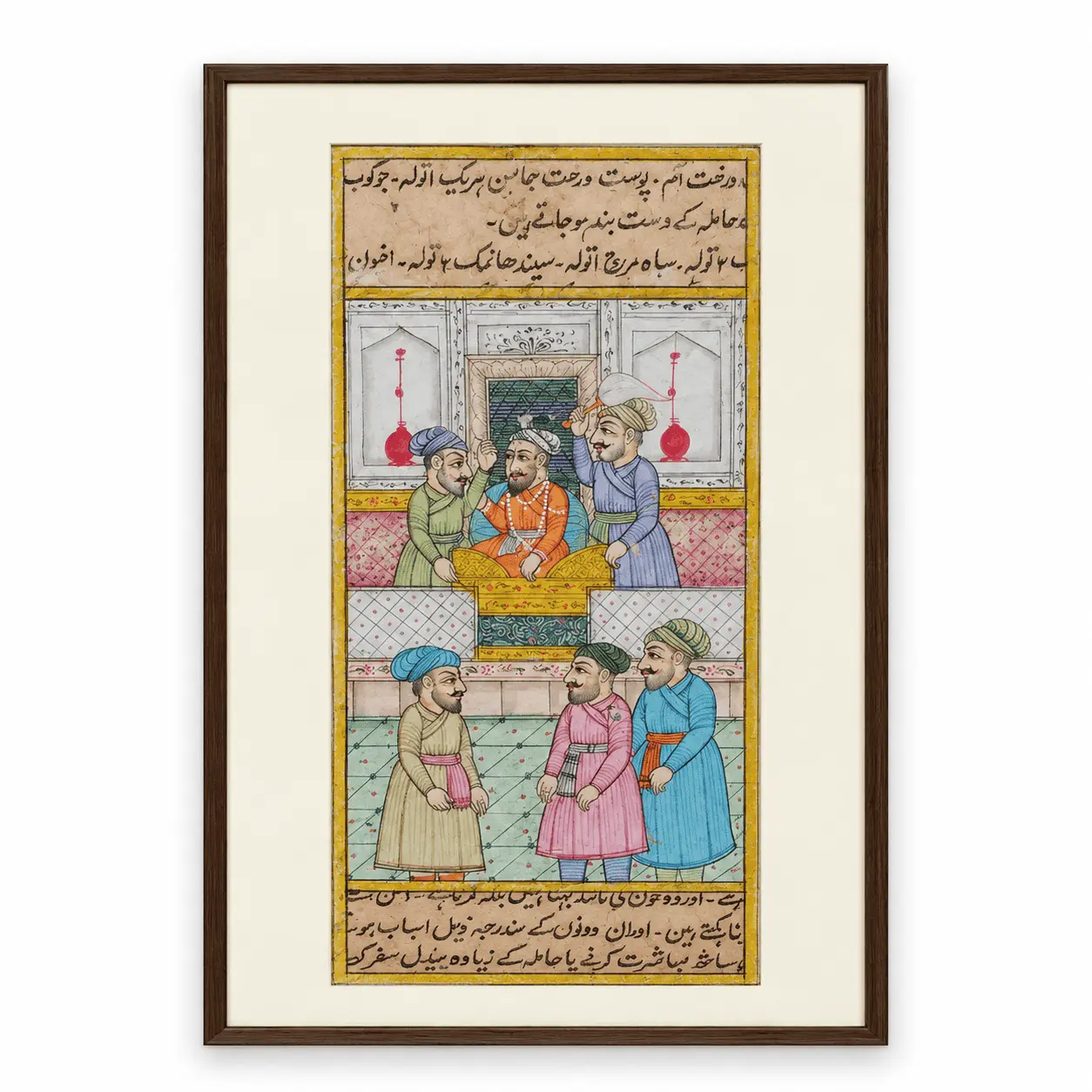
Mughal painting history is the story of how Persian refinement and Indian colour, landscape and realism came together in the courts of India's Mughal emperors. Between the 16th and 19th centuries, royal studios produced small, jewel-like miniatures: portraits, court scenes, hunts and studies of birds and flowers. This guide explains where the style came from, how it changed from one emperor to the next, who the great painters were, and how to start collecting handmade Mughal miniatures today.
What Is Mughal Miniature Painting?
Mughal miniature painting is a small-format court art made with opaque water-based colours on handmade paper. The paintings were created to illustrate books of history, poetry and epics, and later as single pages for imperial albums. Despite their size, they are packed with detail: individual faces, textiles, architecture, animals and plants, all painted with very fine brushes.
The style is a fusion. Its fine lines, patterned borders and jewel-like colour come from the Persian book tradition, while its warm colour, local landscapes, flora and fauna and growing realism come from Indian painting. Later, European prints and paintings added new ideas about space, light and shading.
Origins of Mughal Painting
The roots of Mughal painting lie in Persian miniature traditions, particularly from the Timurid and Safavid courts. Babur founded the Mughal dynasty in India in 1526, but the real beginning of the Mughal school came under his son Humayun. During his exile in Persia he saw the painting of the Safavid court, and when he returned to India in 1555 he brought two Persian masters with him: Mir Sayyid Ali and Abd al-Samad.
The style was built up under Akbar. He kept these masters and asked them to train Indian artists in a large imperial studio, the karkhana, also known as the tasvir khana. Persian and Indian painters, many of them Hindu artists, worked side by side, and this exchange produced the distinctive Indo-Persian art form that became a hallmark of Mughal identity.
Mughal Painting History at a Glance: Timeline
| Period | Ruler | What happened in painting |
|---|---|---|
| 1526–1530 | Babur | The dynasty is founded. Persian and Timurid book culture shapes court taste. |
| 1530–1540 and 1555–1556 | Humayun | After exile in Persia, he returns with Mir Sayyid Ali and Abd al-Samad. |
| 1556–1605 | Akbar | The imperial atelier grows. The Hamzanama and other great manuscripts are illustrated. |
| 1605–1627 | Jahangir | Portraits, nature studies and single-page album paintings become the focus. |
| 1628–1658 | Shah Jahan | Formal darbar scenes, rich ornament, architecture and decorative borders. |
| 1658–1707 | Aurangzeb | Imperial patronage reduces. Artists move to regional courts. |
| 18th–19th century | Late Mughal and regional courts | A brief revival under Muhammad Shah (1719–1748) with romantic and leisure themes, then continuation in places such as Lucknow, Murshidabad and Hyderabad, mixing with local traditions. |
How Mughal Painting Developed Under the Emperors
Akbar's court (1556–1605)
Akbar's reign is when Mughal painting became a royal enterprise. His studio illustrated vast projects such as the Hamzanama, an epic of about 14 volumes with some 1,400 large paintings, as well as histories such as the Akbarnama. The style emphasised storytelling, movement and vivid colours, and the Akbarnama pages show a growing interest in European ideas of space and shading.
Jahangir's court (1605–1627)
Jahangir was a connoisseur of art and nature, and many consider his reign the high point of Mughal painting. Focus moved from large narrative scenes to portraits, studies of birds, animals and flowers, and single-page album paintings. He prided himself on recognising the hand of individual painters.
Shah Jahan's court (1628–1658)
Known for architectural marvels like the Taj Mahal, Shah Jahan also encouraged refined portraiture and scenes of royal grandeur. Paintings became more formal, with symmetry, opulence, gold and detailed backgrounds.
Aurangzeb and the later period (1658–1707)
Reduced imperial patronage during Aurangzeb's reign led to a decline of the court studio. Mughal art survived in regional courts such as Lucknow, Murshidabad and Hyderabad, blending with local traditions.
For a closer look at how each of the three great emperors shaped the style, read Akbar vs Jahangir vs Shah Jahan: How Each Emperor Changed Mughal Painting Style.
Characteristics of Mughal Painting
Mughal paintings can be recognised by certain key features:
- Miniature format: small in size but intricate in detail.
- Portraiture: lifelike representations of emperors, nobles and courtiers.
- Persian influence: fine lines, delicate brushwork and Persian motifs.
- Indian elements: rich colours, local landscapes, textiles, and flora and fauna.
- Naturalism: careful observation of faces, animals and plants, increasing from Akbar's time onwards.
- Themes: court scenes, battle depictions, hunting expeditions, mythology and nature studies.
Materials: Natural Pigments, Wasli Paper and Gold
Mughal painters worked with natural pigments ground from minerals and plants, such as lapis lazuli for blue, malachite for green, vermilion for red and ochre for yellow. Traditional miniatures are painted on wasli, a handmade paper built up from several thin layers and burnished smooth, and fine details and gold highlights are added with very fine squirrel-hair brushes. These materials give a miniature its matte, deep colour and warm, aged character. To learn more, read how to identify authentic Mughal miniature paintings.
The Six Main Themes of Mughal Miniature Painting
Mughal artists returned again and again to a few great themes. Each one is available as a handmade painting at Rupasya:
- Hunting scenes (shikar): the royal hunt showed the ruler's power and the artist's skill at painting animals in motion.
- Royal processions: imperial convoys of elephants, howdahs, palanquins, flag-bearers and musicians.
- Portraits: one of the great strengths of Mughal painters, from emperors to courtiers.
- Palace life and harem scenes: couples on terraces, moonlit pavilions and garden settings.
- Persian legends and fantasy: the Shahnameh, the Simurgh, dragons and animal fables in the Mughal style.
- Court life and genre scenes: music, justice, nature studies and everyday life at court.
Famous Mughal Painters
The Mughal court attracted some of the greatest artists of the time, including:
- Mir Sayyid Ali: early Persian painter who came with Humayun and worked in Akbar's court.
- Abd al-Samad: another Persian master and Akbar's chief artist.
- Basawan: one of Akbar's leading Indian painters, known for strong composition.
- Govardhan: known for expressive portraits.
- Abul Hasan: a leading painter of Jahangir's court, remembered for portraits and allegorical scenes.
- Bichitr: court painter during the reigns of Jahangir and Shah Jahan.
- Ustad Mansur: renowned natural history painter, famous for birds and animals.
Mughal Art and Related Traditions
Mughal painting did not evolve in isolation. It interacted with other traditions:
| Tradition | Where it developed | How it looks |
|---|---|---|
| Mughal | Imperial courts of the Mughal emperors | Realistic, fine portraiture, Persian-influenced composition |
| Rajput (Rajasthani) | Hindu Rajput courts | More vibrant, religious and narrative, with bolder colours and stylised figures |
| Persian | Timurid and Safavid courts | Flat patterning, jewel-like colour, illustration of poetry and legends |
| Deccan | Regional courts of central India | Absorbed Mughal style and added local aesthetics |
If you love the bolder colours of the Rajput tradition, explore our Rajasthani miniature painting guides.
Decline and Legacy
By the late 18th century, the weakening of Mughal power and the rise of British colonial rule led to the decline of court painting. However, its influence persisted:
- Regional courts continued the tradition in hybrid forms.
- Museums and collectors preserved Mughal miniatures for future generations.
- Today, artists in Rajasthan, including Udaipur and Jaipur, still revive Mughal miniature techniques.
Mughal Art in the Modern World
Mughal paintings are now preserved in major collections worldwide, including the British Museum, the Victoria & Albert Museum, the Metropolitan Museum of Art and the National Museum, Delhi. Collectors and scholars continue to study them for their historical, artistic and cultural value.
In modern times, these paintings are also recreated as handmade artworks by skilled Indian artists, keeping the traditional techniques alive. Rupasya's Mughal miniatures are 100% handmade on old paper with natural stone pigments and delivered framed, and collectors can also request a bespoke custom Mughal miniature inspired by Mughal themes.
How to Start Collecting Mughal Miniatures
- Choose a theme you love: hunting, processions, portraits, palace life, legends or court life.
- Check authenticity: paper, natural pigments, brushwork and a certificate. Our buyer's guide to identifying authentic Mughal miniature paintings explains each step.
- Pick your size and budget. Handmade Mughal miniatures at Rupasya range from ₹5,500 for smaller works to ₹57,500 and above for large, complex compositions.
- Browse the collection: handmade Mughal miniature paintings for sale, delivered framed, with free shipping across India and worldwide delivery.
Conclusion
Mughal paintings are more than works of art. They are documents of an era, showcasing the splendour of imperial courts, the cultural synthesis of India and Persia, and the delicate craftsmanship of Indian artists. From Akbar's monumental manuscripts to Jahangir's naturalistic portraits, Mughal art remains one of the most significant contributions to the world's artistic heritage. Explore the full collection of Mughal miniature paintings to bring a piece of that heritage home, or continue reading in our Mughal miniature knowledge hub.
References
- Metropolitan Museum of Art, Mughal Painting
- Victoria & Albert Museum, Mughal Miniature Paintings
- Khan Academy, Mughal Miniature Painting
- Encyclopaedia Britannica, Mughal Painting
- Wikipedia, Rajput painting
- National Museum, Delhi, Mughal Art Collection
Frequently Asked Questions
What is Mughal miniature painting?
It is a small, highly detailed painting style from the Mughal courts of India, made between the 16th and 19th centuries. It combines Persian and Indian traditions and shows court scenes, portraits, hunts, processions and nature studies. The paintings were made with natural pigments on handmade paper, first for books and later for imperial albums.
Who started Mughal painting?
Humayun laid the foundation when he returned to India in 1555 with the Persian masters Mir Sayyid Ali and Abd al-Samad. His son Akbar then built them into a large imperial studio where Persian and Indian artists worked together. That studio created the Mughal school of painting and trained generations of painters.
What is the difference between Mughal and Rajasthani painting?
Mughal painting is usually more realistic and portrait-focused, with Persian-influenced composition and refined detail. Rajasthani painting is more vibrant, symbolic and narrative, with bolder colours and stylised figures, and often shows religious and folk themes. Both are miniature traditions, but they grew in different courts with different tastes.
Which Mughal emperor did the most for painting?
Akbar established the imperial studio and its great manuscripts, while many consider Jahangir's reign the peak of Mughal painting because of its lifelike portraits and nature studies. Shah Jahan kept the patronage going with a more formal, ornamental style. Each emperor left a clearly different mark on the art.
Can I buy an original Mughal miniature painting?
Yes. Rupasya sells 100% handmade original Mughal miniatures on old paper, painted with natural stone pigments and delivered framed, with a Certificate of Authenticity. You can browse ready-made paintings by theme, or request a custom Mughal miniature inspired by court scenes, hunts, portraits or processions.