
Pichwai The Sacred Art of Nathdwara
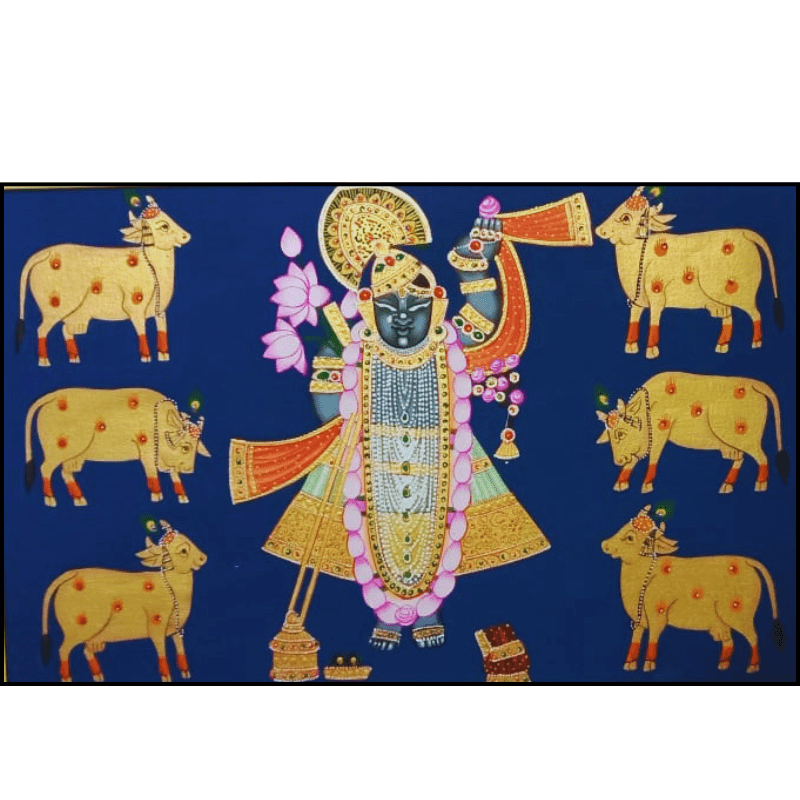
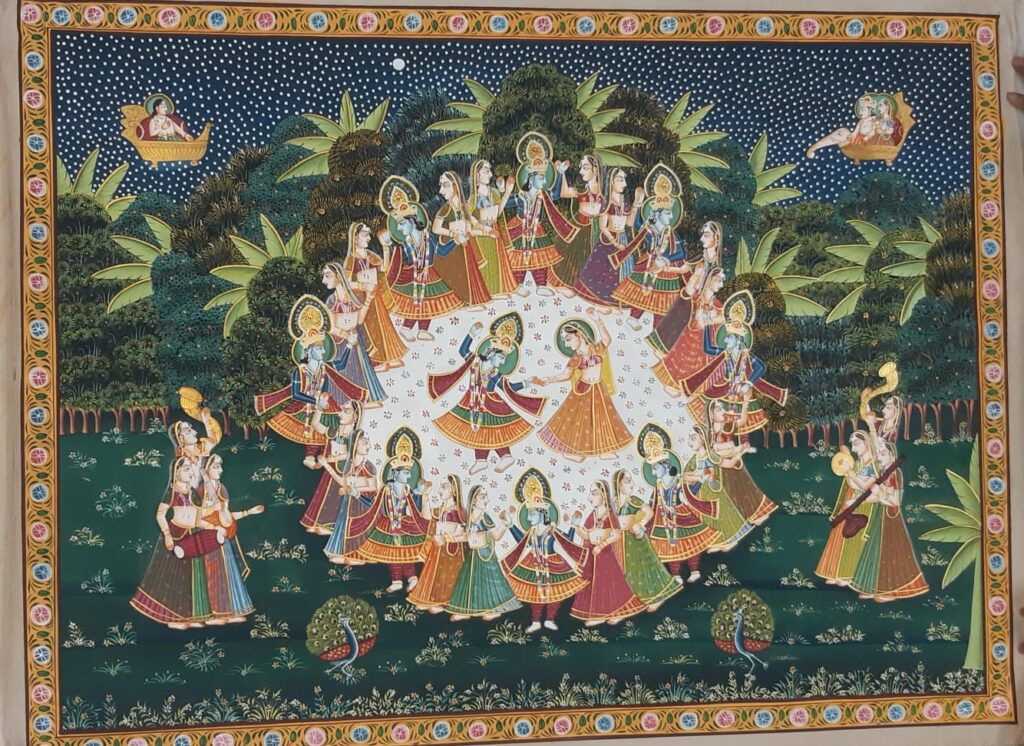
Nathdwara painting is a traditional art form that started over 400 years ago in Nathdwara, a small town in Rajasthan, India. Nathdwara is located in the Rajsamand district. This art has many styles, but the most famous one is called Pichwai. The word Pichwai comes from two Sanskrit words: pich meaning “back” and wais meaning “hanging”. So, a Pichwai is a cloth painting that hangs behind the idol of the Hindu god Shrinathji.
How It Began
In the beginning, Pichwai paintings were made as offerings during special festivals and holy days, especially during the monsoon season. Devotees would travel from far away to visit the temple. They wanted to take the feeling of the temple back home with them. So, the artists began to paint the idol of Shrinathji in the center of the cloth. This made the Pichwai a complete piece of art that people could keep in their homes.
The Story of Prakatya
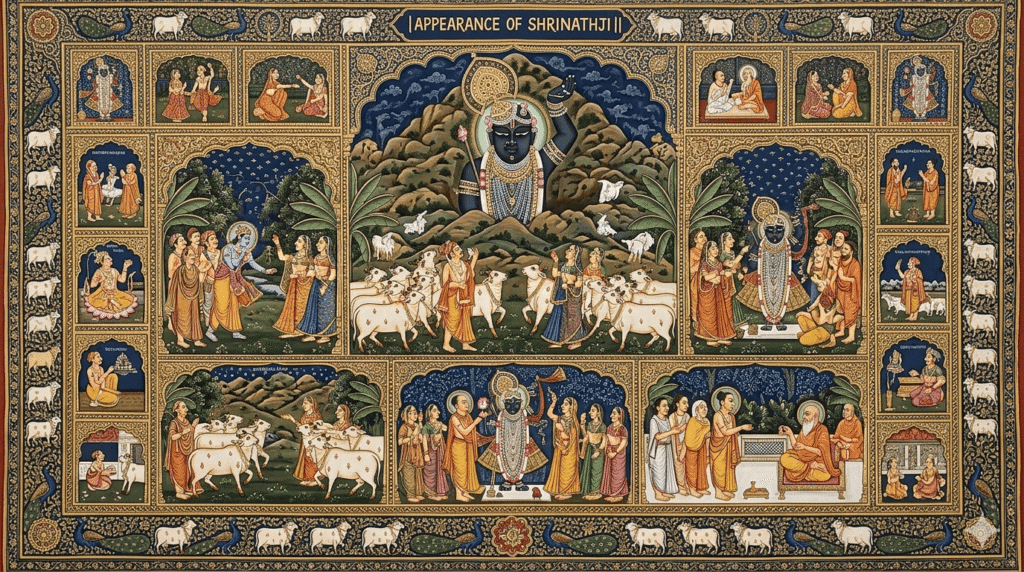
There is a beautiful story behind the Shrinathji idol. It is said that in 1409 CE, a raised arm appeared among the blue rocks of Mount Govardhan. People recognized it as the arm of Shri Krishna, who lifted the mountain to protect villagers from a great storm.
Later, in 1478, the face of Shrinathji appeared on the same mountain. Around this time, a cow named Dhumar, who belonged to a man named Saddu Pande, began leaving her herd. She would go to a secret spot to offer her milk to Shri Krishna.
In 1492 CE, a great teacher named Vallabhacharya had a dream. In the dream, Shrinathji asked him to come to Govardhan. Vallabhacharya went there with his students. One day, he saw Dhumar leaving the herd and followed her. He was amazed to see the cow offering milk to a half-buried idol. When Vallabhacharya came close, Shrinathji appeared and embraced him like a long-lost friend.
The Nathdwara School of Painting
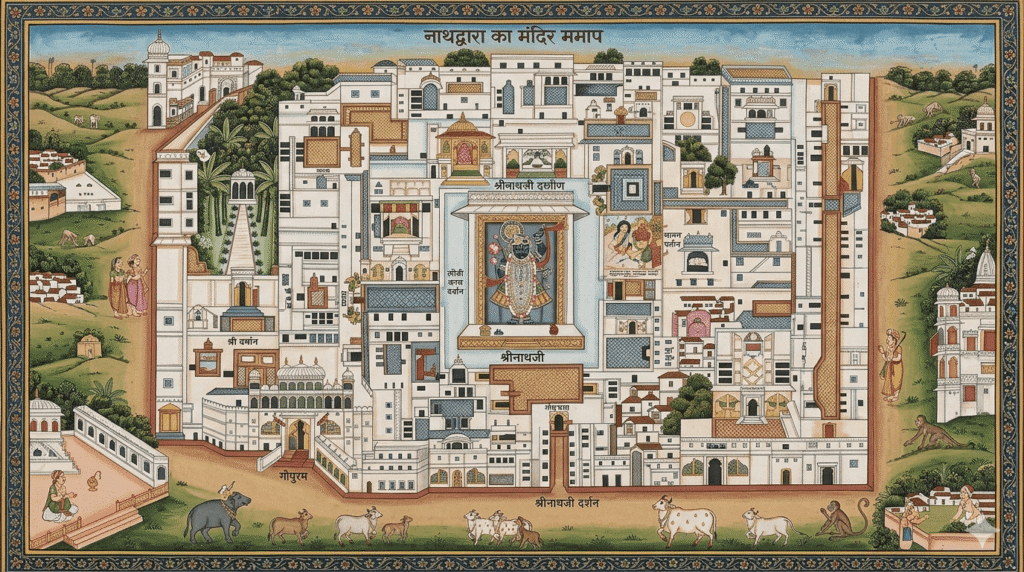
The name Nathdwara means “Gate of God” (Nath = God, Dwara = Gate). It is like the gates of heaven. The Nathdwara style is a part of the larger Mewar school of painting, which also includes art from Udaipur and Devgarh. The Shrinathji temple in Nathdwara became a center for art and creativity.
In 1670, the idol of Shrinathji was moved from Mathura to Nathdwara to keep it safe from the Mughal emperor Aurangzeb, who did not like idol worship. After this, many artists came to Nathdwara. They were inspired by their devotion and began painting beautiful images of Shrinathji. One famous artist was Acharya Gopinathji.
Special Features of the Art
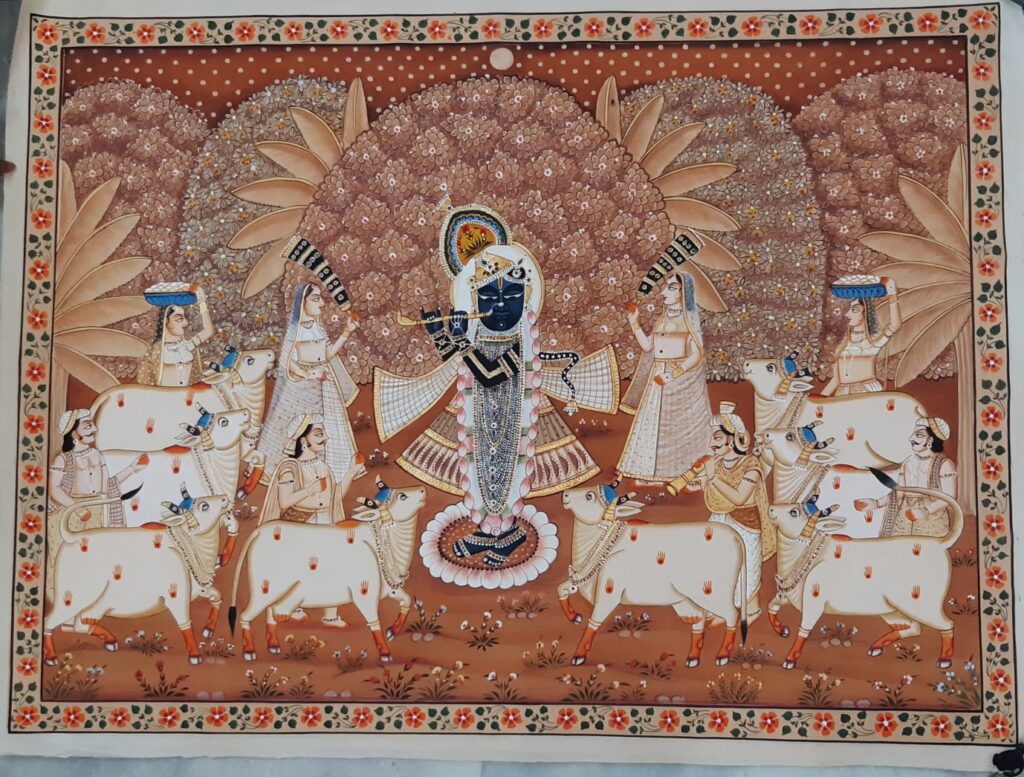
Nathdwara paintings have a special look. They are well balanced and use deep colors. Blue is used a lot because it is the color of Lord Krishna. The paintings often show Krishna lifting Mount Govardhan, which is a very important scene.
The human figures in these paintings follow a set style. The women are shown as elderly. The men are strong and have heavy bodies. Krishna’s young friends are shown as playful and full of emotion.
One unique feature of Nathdwara art is the cows. The cows are white with soft, doe-like eyes. Their horns, legs, and shoulder humps are often dyed with henna. These beautiful cows are a special mark of this painting style.
Where Artists Find Ideas
The artists of Nathdwara find their ideas from poems and songs written by devotees. These poems tell the stories of Krishna’s life and his playful acts. Another source of inspiration is the Rasa Leela, which is the story of Krishna dancing with the Gopis (cowherd women).
The main idol of Shrinathji in the temple is a stone relief with a rectangular background. Painting this idol is different from painting a three-dimensional statue. The artists have developed a special way to show this form on cloth.
How Pichwais Are Made
Making a Pichwai is often a group effort. Many skilled painters work together under the guidance of a master artist. They usually belong to the same community and have learned the art from their families.