The Secret Ingredients of Mughal Paintings: 24K Gold & Natural Pigments
Mughal miniature paintings are not just artworks; they are a marvel of ancient chemistry and extreme patience. If you look at a 400-year-old Mughal painting in a museum today, the colors look as fresh as if they were painted yesterday.
How is this possible? The secret lies in the ingredients. While modern mass-produced art uses synthetic chemicals, authentic Mughal art uses precious stones, real gold, and organic extracts. At Rupasya, our master artists in Udaipur continue to use these “Royal Secrets” to create every single piece.
1. Colors from the Earth: The Magic of Natural Pigments
In the world of miniature art, the palette is literally made of gemstones. These are called Natural Pigments. They are expensive and difficult to prepare, but their glow is unmatched.
- Lapis Lazuli (The Royal Blue): This deep blue comes from a semi-precious stone imported from the mountains of Afghanistan. The stone is ground into a fine powder, washed multiple times, and mixed with a binding agent.
- Malachite (The Deep Green): To capture the lush gardens of the Mughal era, artists use crushed Malachite. It provides a rich, forest-green texture that synthetic paint cannot replicate.
- Cinnabar & Hingul (The Eternal Reds): These minerals provide the vibrant red seen in royal robes and curtains.
- Yellow Ochre (Ramraj): Sourced from the earth, this gives the paintings a warm, golden-yellow sunlight effect.
2. The Golden Glow: 24K Gold & Silver Leaf
The most striking feature of a Rupasya Mughal painting is the shimmer. This is not gold-colored paint; it is authentic 24K Gold Leaf (Vark).
- The Process: Pure gold is beaten into incredibly thin foils.
- The Application: The artist applies a special adhesive to the “Wasli” paper and carefully places the gold foil using a delicate brush. Once dried, it is rubbed with an Agate stone (Haqiq) to give it a brilliant, mirror-like shine.
- Why Gold? Gold represents the sun, divinity, and the supreme status of the Mughal Emperors. Unlike fake metallic paints, real gold leaf never turns black or fades.
3. The "Kajal" Technique: The Secret of the Black Outline
Have you noticed the hair-thin black outlines in Mughal art? These are not made with ink pens.
Artists create “Kajal” (Lampblack) by burning a wick in a lamp filled with mustard oil or ghee. The soot (kaala dhuan) collected on a copper plate is then mixed with gum arabic. This creates the deepest, most permanent black in the world, used for drawing eyes, hair, and the borders of the painting.
4. Saffron & Flowers: Organic Extracts
Mughal art also uses the “essence of nature.”
- Saffron (Kesar): High-quality saffron is soaked in water to create a warm, glowing orange/yellow. This was historically used to give a “royal glow” to the skin tones of kings and queens.
- Indigo: Derived from the Indigofera plant, this provides a unique dark blue-black shade used for night skies.
5. The Specialized Tools: Squirrel Hair & Wasli
The ingredients are precious, but the tools are even more specialized.
The Single-Hair Brush
To paint details like the thread of a garment or the pupil of an eye, artists use brushes made from squirrel hair. Specifically, the hair is taken from the tail of a squirrel (without harming the animal). These hairs are so fine that a “zero-number” brush might contain only a few strands of hair.
Wasli: The Foundation
A regular paper would tear under the pressure of stone colors. Wasli is a handmade, acid-free paper made by fusing 3 to 4 layers of thin paper together using a starch-based glue (called Lai). This results in a sturdy, cardboard-like surface that can last for centuries.
6. How to Care for Your Gold-Leaf Miniature Painting
Since these paintings are made with natural minerals and organic materials, they need a little love to stay perfect:
- Avoid Direct Sunlight: While stone colors are durable, the “Wasli” paper can age if kept in harsh, direct UV light for years.
- UV-Protected Framing: Always use high-quality glass or acrylic with UV protection when framing your Mughal art.
- No Humidity: Keep the art in a dry environment. Moisture can react with the handmade glue in the Wasli paper.
- No Direct Cleaning: Never touch the surface of the painting with a wet cloth. A light dusting with a dry, soft feather-brush is enough.
Why Buying Authentic Matters
When you shop at Rupasya, you are supporting a 400-year-old lineage of artists. A painting made with natural pigments and 24K gold is not just a product; it is a family heirloom that you will pass down to the next generation. Its value increases as these traditional techniques become rarer.
Experience the Grandeur of Mughal Art
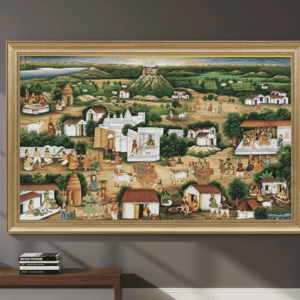
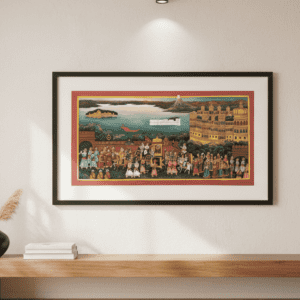
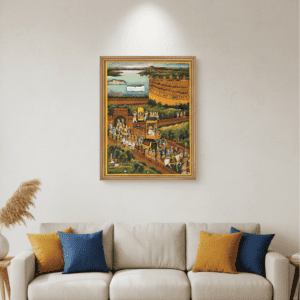
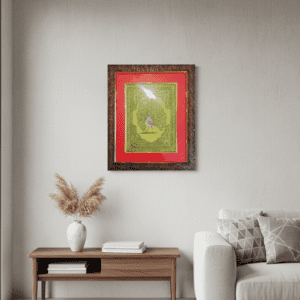
Ready to bring a piece of the royal court into your home? Our collection features the finest handmade miniatures crafted with the exact “Secret Ingredients” mentioned above.
[Browse Our Exclusive Mughal Collection Here] (Link: https://rupasya.com/mughal-miniature-paintings/)